This essay was originally published on my (now-defunct) Substack newsletter on 02/11/23.
Mathematicians don’t like mistakes. Maths with mistakes isn’t maths; it’s just nonsense. No wonder that maths lecturers, at least the more traditional ones, prefer to use chalk on blackboards or pencil on paper, because then you can always rub out your mistakes. I still remember this one lecture I had at university where a professor filled six entire whiteboards full of maths over a period of around thirty minutes, so half a one-hour lecture. Only when he started to use the eraser, he realised that nothing was coming off the whiteboards. He looked down at the pen he was using. Permanent marker. Oh dear. He decided to end the lecture early. I wish I had seen the face of the next lecturer who had to teach in there immediately afterwards.
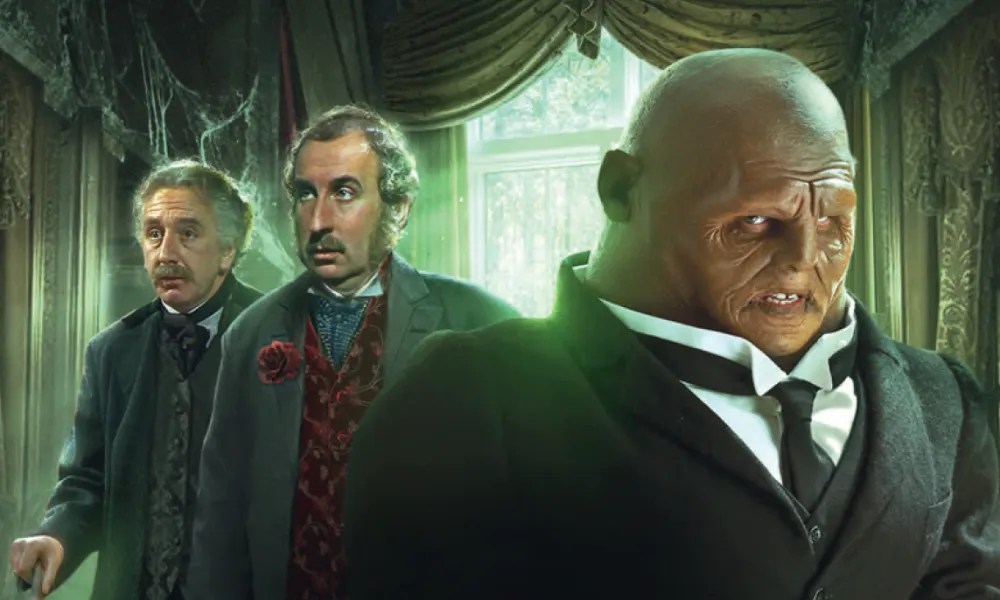
There’s a mistake about prime numbers in the Big Finish audio drama Jago & Litefoot & Strax: The Haunting. But before I can go there, I probably need to explain what on earth a Jago & Litefoot & Strax actually is. The prime numbers can wait.
Henry Gordon Jago and Professor George Litefoot, portrayed respectively by Christopher Benjamin and Trevor Baxter, are the two main supporting characters in the 1976 Tom Baker serial The Talons of Weng-Chiang, which is set in the Victorian era. Big Finish Productions then revived the characters in a 2009 ‘Companion Chronicle’ release entitled The Mahogany Murderers, and considered this such a success that they decided to give them their own spin-off series. The spin-off series ran for fourteen boxsets, as well as a number of special releases, between 2010 and 2021, ultimately curtailed by the death of Trevor Baxter in July 2017 [1].
Meanwhile, Strax is a Sontaran, portrayed by Dan Starkey, who first appeared in the 2011 Matt Smith episode A Good Man Goes to War. During the episode he fights on behalf of the Doctor and dies in the course of battle. Writer Steven Moffat then later decides to write a 2012 ‘minisode’ that explains, actually, he’s not dead but rather he just fainted and woke up two days later [2]. He is adopted by Vastra, a Silurian lady portrayed by Neve Macintosh, and Jenny, a human lady portrayed by Catrin Stewart, who live in London during the Victorian era and Strax becomes their butler-in-residence. Collectively, they are known as the Paternoster Gang and have appeared in several subsequent episodes between 2012 and 2014 and have even had their own eponymous Big Finish spin-off range since 2019.
In 2015, Big Finish Productions not only renewed their license to make Doctor Who audio dramas for another five years but they were also permitted for the first time to utilise characters who had been established in the TV show since its television revival in 2005. Jago & Litefoot & Strax: The Haunting was one of the first two releases from Big Finish to utilise this new aspect of their license agreement in November 2015, though it was arguably more unexpected than the new series UNIT spin-off that also arrived that same month. But hey, if you have three Doctor Who characters who all live in Victorian era and they are all played by three actors in need of some work, why wouldn’t you try and make some dough?
Penned by Justin Richards, Jago & Litefoot & Strax: The Haunting is actually a rather fun listen. The plot involves Strax suffering from confusion after he is attacked and then finds himself teaming up with Jago and Litefoot, who he keeps mistaking for Vastra and Jenny. Together, they follow the trail of a creature who is stealing people’s brains and it leads them to a haunted house within Victorian London. It feels exactly like the sort of Doctor Who sitcom premise that Steven Moffat would write for the characters if he were given the opportunity.
Around five minutes into the first half of this audio drama, Strax is accosted by a woman who calls herself Mrs Maltravers. She subjects him to a series of questions so as to ascertain his intelligence. The first of these questions is “What is the next number in this sequence: 1, 3, 5, 7, 11?”. Strax retorts “They are obviously prime numbers so the next number in the sequence is 13.” He is told he has passed the first question, but then proceeds to fail the second question by giving an overly violent answer to a logic puzzle involving a flooded room. Typical Strax. He has, unsurprisingly, failed the intelligence test. But unfortunately, so has Mrs Maltravers.
A prime number p is a positive whole number that has exactly two unique divisors, which are 1 and p itself. The number 3 is prime because it meets this definition; it has exactly two unique divisors, 1 and 3. The same holds true for the numbers 5, 7 and 11. The number 4 is not prime because it does not meet this definition.; it has three unique divisors: 1, 2 and 4. As I’m sure you already know, 3 is more than 2. The same holds true for the numbers 6, 8, 9 and 10. Such numbers are known as composite numbers, because they are composed of multiple primes.
The common misconception that people hold about primes is that they believe 1 is a prime number because it meets the rule that it is divisible by 1 and itself. But what they neglect to note is that this is the special case where 1 and ‘itself’ are actually the same number. This means that the number 1 has exactly one divisor. As I’m sure you already know, 1 is less than 2. Therefore, it does not meet the definition of a prime number. The number 1 is the only positive whole number that does not have a prime factorisation; it is neither prime nor composite. It is, quite fittingly, unique.
Another reason we can be sure that 1 is not a prime number is because it would break the Fundamental Theorem of Arithmetic. We know this is a very important theorem in mathematics because it has the word ‘fundamental’ in its name. The Fundamental Theorem of Arithmetic states that every positive whole number except 1 has a unique prime factorisation. If we know the prime factorisation of a number then, in the abstract world of maths, we can identify exactly what number it is. Knowing the prime factorisation is like having a special barcode for each and every whole number – it’s very powerful stuff!
For example, the unique prime factorisation of 6 is 3 x 2 (or 2 x 3 – we’re not bothered about the order, just the combination of primes). But then, if we introduce the number 1 as a prime number, we would end up breaking the Fundamental Theorem of Arithmetic. The prime factorisation of 6 would then be not only 3 x 2, but also 3 x 2 x 1, and 3 x 2 x 1 x 1, and 3 x 2 x 1 x 1 x 1, and so on. Now that doesn’t sound unique at all, does it?
So then, if someone ever asks you why the number 1 isn’t a prime number, you can now reply “Because if 1 was a prime number then this would break the Fundamental Theorem of Arithmetic and we really, really don’t want to do that.” It’s not quite up there with “Mitochondria is the powerhouse of the cell,” or “Vortex manipulators are cheap and nasty time travel,” but I’m still hoping it will catch on. Anyway, I hope I have now managed to obliterate any notion in your head that the number 1 might be a prime number.
But… that doesn’t mean that mathematicians have historically thought of 1 as a prime number. A quick glance at the definition of a prime number on Wolfram Alpha can give you at least six or seven different references for this. But as the same webpage specifies “it require[d] special treatment in so many definitions and applications” when it was considered to be a prime that it just made better sense to just say that it isn’t prime. TARDIS Wiki even has a note on the webpage for this story, stating that:
“It was not uncommon to consider 1 prime at the time the story is set. In particular, the entry for Number published in 1890 in the 9th edition of Encyclopædia Britannica stated that every positive number was either prime or composite and explicitly listed 1 as prime.”
So then, in all fairness, it’s not actually unreasonable for the number 1 to be considered prime within the realms of this particular Doctor Who audio drama. We can actually just ascribe this to Mrs Maltravers being acquainted with the mathematical understanding of the time period.
Wait – hang on a moment. I said there was a mistake, and yet now I’m defending the explanation given by TARDIS Wiki. Then what was the point of going through all that maths?
I’ll tell you why.
Because 2 is also a prime number, and yet it’s not in Mrs Maltravers’s sequence. The number 2 is the first prime number. It is the only even prime number. It has been known to be prime for over two millennia [3]. And TARDIS Wiki doesn’t have any explanation for this!!
How long until this blog gets cited by TARDIS Wiki?
Start the clock.
>
Footnotes
[1] The final boxset, Series 14, was released in June 2021 as a series of audiobooks instead of the usual full-cast audio dramas.
[2] The Battle of Demons Run: Two Days Later. You can find it on Doctor Who: The Complete Seventh Series on DVD and Blu-Ray (and probably online).
[3] Using the ‘Sieve of Eratosthenes’, an ancient algorithm used for identifying primes.

 The Brain of Möbius
Leave a comment