This essay was originally published on my (now-defunct) Substack newsletter on 05/10/23.
Doctor Who fans are obsessed with continuity. We really cannot help ourselves. There must be some sort of in-built desire within fans to have everything link together, to make sense of it all. Otherwise, Doctor Who isn’t actually this elaborate Unfolding Text that people like to claim that it is, but rather a disorganised, unconnected mess of events that we just like to pretend all link together somehow. Some fans, would you believe, even like to make lists of all the bits that don’t make sense, or contradict something that was previously said, and then, here’s the clever bit, they put it on TARDIS Wiki for everyone to see. It’s as if they are saying, “Look at me! I’m keeping track of all the Doctor Who. Are you?”
Frankly, no.
I haven’t got the time or energy to process All Of The Doctor Who. There’s simply too much. In fact, I’ve recently just finished watching every (surviving) episode of the Classic series – that’s taken me ten years already! How long is it going to take me to finish all the Expanded Universe ‘content’ produced over the past six decades? Don’t even get me started on the fan-fiction. I know now that I’ve experienced enough Doctor Who to know that it’s never all going to finally make sense.
We must face facts here, dear reader. Doctor Who doesn’t make complete sense.
One of the main contributors to the ever-increasing volumes of Expanded Universe content is Big Finish Productions. Big Finish is an independent production company that has held the license to make Doctor Who audio dramas for nearly 25 years, and it will continue to do so for the foreseeable future. This license allows them to develop upon what has been established within the TV show, provided that their storylines are formally approved by the BBC.
In 2009, they released a story where the Eighth Doctor, played by Paul McGann, meets the historical literary figure, Mary Shelley. You know her, the one that wrote Frankenstein. As Mary Shelley had never featured in Doctor Who before, chronologically-speaking [1], this story entitled The Company of Friends: Mary’s Story documents the first time that the Doctor and Mary Shelley have met. Then, in 2011, Big Finish released a trilogy of audio dramas that chronicle Mary Shelley’s travels with the Eighth Doctor as a companion. This makes her quite important in the canon of Doctor Who characters. Because she’s, you know, a companion. One of the closest associates of the title character, practically a best friend. She knows who the Doctor is. She knows what the TARDIS is. She has a concept of travelling through time and space. In the first of this trilogy of stories, entitled The Silver Turk, she meets a Cyberman called Gramm. This story then documents the first time that Mary Shelley and a Cyberman have ever met.
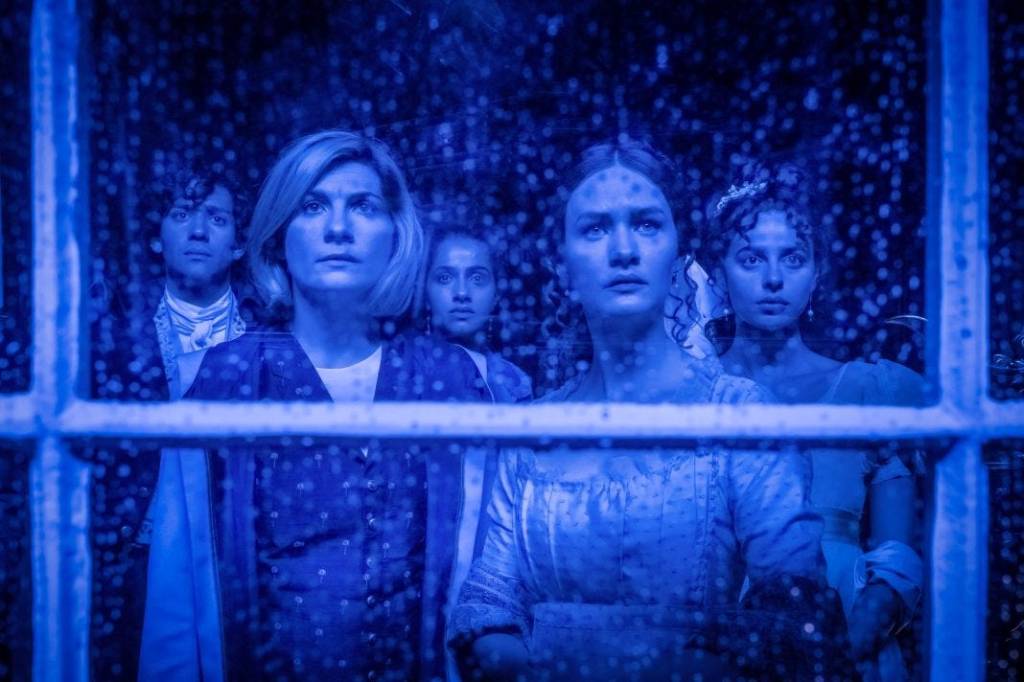
Then, in 2020, The Haunting of Villa Diodati was broadcast on BBC One. In this TV episode, the Thirteenth Doctor, played by Jodie Whittaker, meets the historical literary figure, Mary Shelley. At no point during the episode is it acknowledged that the Doctor has previously met, or indeed travelled, with Mary Shelley. Therefore, this story also documents the first time that the Doctor and Mary Shelley have met. Then, later on, in this same TV episode, the Doctor and Mary Shelley encounter a Cyberman called Ashad. At no point during the episode is it acknowledged that Mary Shelley has previously encountered a Cyberman. Therefore, this story also documents the first time that Mary Shelley and a Cyberman have ever met.
In the words of Gramm the Cyberman from The Silver Turk, “There is no logic here.” Why does the Doctor, who has encountered Mary Shelley and a Cyberman during his Eighth incarantion, in adventures that count as officially licensed Doctor Who products, not have any memory of these events when she subsequently encounters Mary Shelley and another Cyberman during her Thirteenth incarnation, in an official Doctor Who television episode? Any members of the audience who are aware of all these pieces of information have yet to be provided with an explanation as to why this is. Therefore, we are forced to conclude that Doctor Who doesn’t make complete sense.
One of the most well-known and well-documented continuity screw-ups in the history of Doctor Who is the so-called ‘UNIT dating controversy.’ I will try and keep this as brief as possible.
In The Web of Fear, we learn through dialogue that the events of this story must be set approximately around the year 1975. This is because the Second Doctor and his companions met another character called Edward Travers in a previous adventure, The Abominable Snowmen. which was explicitly set in the year 1935 and we are told that this adventure happened “over forty years ago”. The Web of Fear also introduces the character of Colonel Lethbridge-Stewart.
The Colonel then reappears in The Invasion, but now he’s been promoted to the rank of Brigadier and has established the military force known as UNIT. This story is set approximately around 1979. We know this because we learn through dialogue that the Brigadier last encountered the Doctor and Jamie “four years ago.” So far, so good. After having several adventures with the Third and Fourth Doctors, the Brigadier then returns in a subsequent adventure with the Fifth Doctor, entitled Mawdryn Undead, where we are told that he retired from UNIT in the year 1976.
Oh bugger.
The UNIT dating controversy is so notorious among Doctor Who fans that it even has its own special documentary, entitled ‘The UNIT Dating Conundrum,’ on the official 2011 DVD release of Day of the Daleks, a story that features both UNIT and alternative timelines. This documentary was subsequently re-released on Doctor Who: The Collection – Season 9 for Blu-Ray, a boxset which features a picture of the Third Doctor who has five fingers and one thumb on his left hand [2].
Think about that for a moment.
This documentary is featured on an officially licensed Doctor Who product that consists of actual TV episodes of Doctor Who, arguably the main canonical text, if we can consider there to be one. Within this documentary, Doctor Who television writer Ben Aaronovitch, and thus a rightful co-author of arguably the main canonical text, states that “There is nothing you can do about [Mawdryn Undead]. It’s just stuffed.” This documentary then explicitly acknowledges that the internal continuity of Doctor Who can never be fully reconciled. And the BBC has decided that you, dear reader, can just buy this product from the shelves of your nearest retailer of such fine goods. Doctor Who still doesn’t make complete sense.
Funnily enough, mathematics also has a well-documented history of people worrying about whether it made sense. This event became known as the ‘crisis of foundations,’ a period of mathematical history when mathematicians were re-examining the roots of their discipline, as they had become uncertain as to whether mathematics was as rigorous as they once thought [3]. This happened during the late 19th and early 20th century when a number of logical paradoxes were identified within mathematics.
A well-known example is Russell’s Paradox, named after the British mathematician and philosopher Bertrand Russell (1872 – 1970). This paradox states that if you define a set to contain all the sets that are not members of themselves, then the set itself neither belongs inside the set nor outside the set, yet logically those are the only two places it could be [4]. This paradox has been adapted into a well-known puzzle called the Barber Paradox. Suppose you have a barber who shaves all those, and only those, who do not shave themselves, then does the barber shave themself? Whichever answer you choose, you end up with a logical contradiction either way. Bertrand Russell then is the equivalent of a Doctor Who fan posting a list of plot holes on TARDIS Wiki. It would also seem that mathematics doesn’t make complete sense.
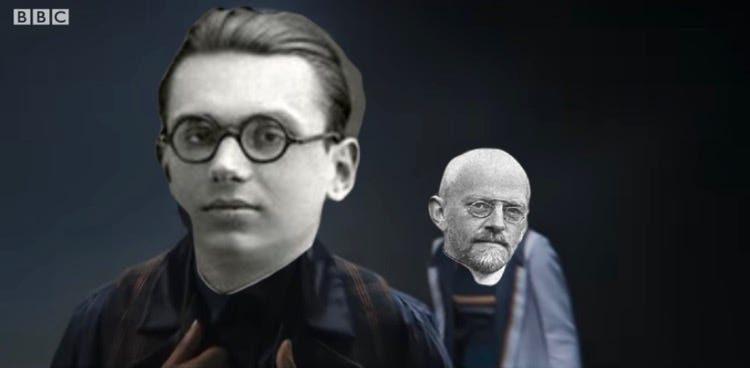
David Hilbert (1862 – 1943) was a German mathematician and one of the leading figures of mathematics during the late 19th and early 20th century. Hilbert became concerned about these paradoxes and decided to do something about it. He started a ‘program’ in the 1920s to solve the foundational crisis once and for all, by attempting to establish a finite and complete set of axioms; these are logical statements that can always be taken to be true and form the basis for a system of logic. These axioms needed to have two properties [5]: completeness and consistency. Completeness means that all true mathematical statements can eventually be proved, given infinite time. Consistency means that there are no logical contradictions in the proofs of any such mathematical statements. David Hilbert then is the equivalent of Doctor Who writers like Craig Hinton and Gary Russell [6], whose novels from the 1990s and early 2000s are noteworthy for their obsession over points of continuity. Nevertheless, Hilbert was determined to find the version of mathematics that made complete sense.
In January 1931, an Austrian mathematician named Kurt Gödel (1906 – 1978) proved that such a version of mathematics did not exist. He had just published his (two) incompleteness theorems. These theorems contained rigorous mathematical proofs for the idea that there exist statements within mathematics that are completely true, but we are unable to prove that they are true. Moreover, these theorems hold true for any mathematical system that you can define. Kurt Gödel then is the equivalent of the Master telling the Doctor, as played by David Hilbert [7], that “everything you knew was a lie” during the events of The Timeless Children.
At the time of their publication, the incompleteness theorems proved controversial, providing a mostly unwelcome conclusion to the foundational crisis of mathematics. To think that, around 100 years ago, there were a group of men (and they were all men) who took mathematics so seriously that they got extremely cross when someone told them that the foundations of their favourite subject were actually quite different to what they had previously thought. We will refrain from comment on the fan reception of The Timeless Children, which is beyond the scope of this essay.
Mathematics was, thus, presented with a choice. It could not have both completeness and consistency, as a consequence of the incompleteness theorems, but it could still have one of them. Since mathematics is fundamentally reliant on logic to actually prove its ideas, it obviously had to choose consistency. You probably worked that out already, didn’t you? Otherwise, they would be called the inconsistency theorems. That would probably be the sort of thing mathematicians have nightmares about.
Thanks to Gödel, we now know that any system of mathematics that does not have any contradictions will never be complete. This means that there exist statements within mathematics that are true, and that people think are true, but now we will never know if they are right. Moreover, we also know that we will never know which statements in mathematics cannot be proven to be true, even though they actually are true. Mathematics then doesn’t make complete sense.
I would argue though that Doctor Who, unconstrained by the shackles of logic, has made the alternative choice here. Doctor Who has chosen completeness over consistency. And what that means is that one day, probably when we are all long gone from this world, Doctor Who will be completed. There will be an actual end to this gargantuan monstrosity of a TV show. Its accompanying torrent of Expanded Universe content will cease once and for all. Even the fan-fiction ever flowing from the keyboards will eventually dry up. At last, every Doctor Who story ever will have finally been told.
And none of it will make any bloody sense.
>
Footnotes:
[1] Did you really think I had forgotten the Doctor Who: Battles in Time comic, The Creative Spark, featuring the Tenth Doctor and Mary Shelley, released in 2008?
[2] Sorry Lee, it was too good not to mention. Love your work.
[3] For a more in-depth and academic discussion on this topic, read this. Or don’t.
[4] The Seventh Doctor confuses a robot by applying Russell’s Paradox in the Virgin New Adventures novel Original Sin, p92-93.
[5] Strictly speaking, there were additional criteria. But we’re just concerned with completeness and consistency here.
[6] This might well be the most flattering thing ever said about Gary Russell in a critical essay about Doctor Who.
[7] David Hilbert wore a Panama hat that’s quite similar to the one worn by the Fifth Doctor. How very Doctor-ish!

 The Brain of Möbius
Leave a comment