This post was originally published on my (now-defunct) Substack newsletter on 19/10/23.
I was commissioned to write up this event by James Ashworth, the new editor-in-chief of DWAS’s Celestial Toyroom fanzine, for his inaugural issue. He wanted no more than 2000 words; I ended up giving him 3800 words. It was a painful edit. As readers have now had the chance to experience the (finely) edited print version, you lovely online folk can now read the full, uncut version. You can also see my Twitter thread with some extremely adequate photographs from the day here.
On Sunday 16th July, at approximately 10am, I found myself in an orderly queue in order to enter Bush Hall in Shepherd’s Bush, along with some 200 other Doctor Who fans. Its official website describes it as an “ornate Edwardian building with a rich history” and that Bush Hall is a “grand and intimate place” to experience live events. The building certainly made things feel somewhat grander than expected; I was just expecting a fun little Doctor Who gathering. One person said to me upon entering that it felt like we were going to church. They weren’t wrong.
Several rows of chairs had been arranged into two blocks, not unlike church pews, with a wide aisle running through the centre (I sat on the groom’s side). There was a large stage at the end of the aisle with speakers set up on either side and a large projector screen filled with the striking image of a Dalek firing its gun whilst surrounded by an array of novelisations.
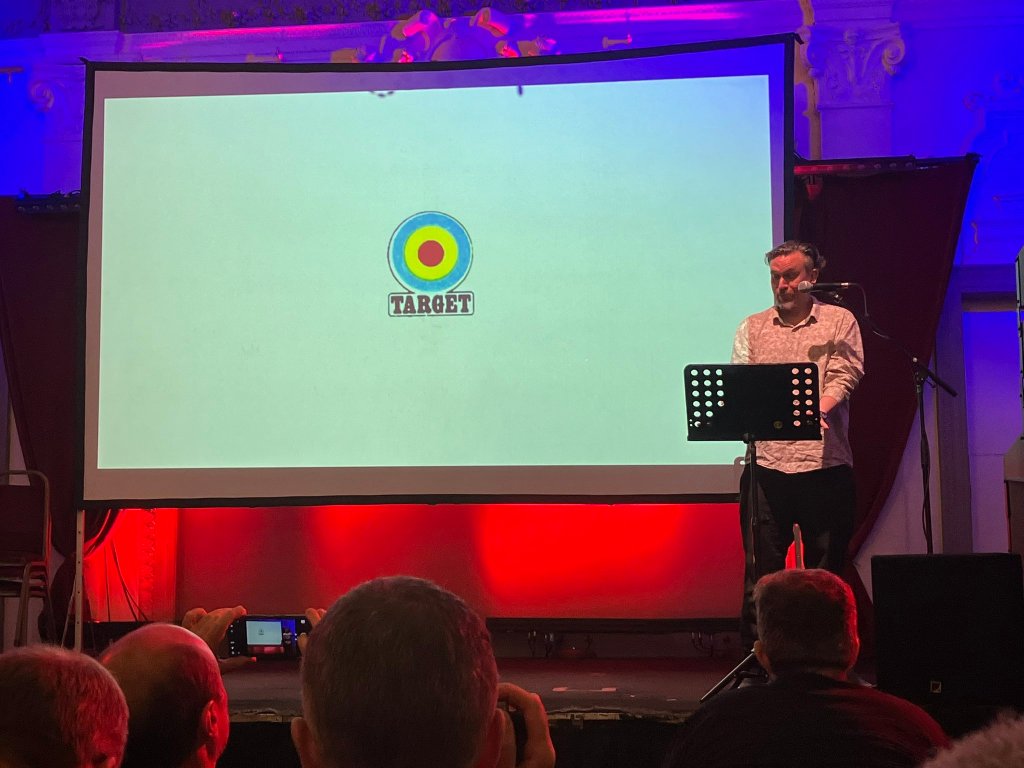
This was The Target Book Club – a celebration of the 50th anniversary of Target Doctor Who books. A day that promised us talks and panels and guests, many of whom had been announced in advance via social media. There was a small bar open for drinks and snacks, Forbidden Planet had a stall set up to sell Target books, and there were even some Target artists who had come along to sell prints of their work.
Preaching from a music stand on the front stage was the event organiser and de facto Master of Ceremonies, James Goss, known for his many contributions to the ranges of Doctor Who books and Big Finish audios among other things. He told us how lovely it was to see us all here and I’m sure everyone else there felt the same in return; Bush Hall is much better than a prison in Turkey. Even Goss could not let the grandeur of the building go uncommented, remarking that he would like to get married there one day. I don’t know how serious he was, but it was a very beautiful building, probably.
Goss had also adorned all our seats with an assortment of paperbacks, audiobooks and Big Finish audio dramas, like some low budget Santa’s Grotto, albeit for the most ardent of Doctor Who fans. I presume these had been left stuck in a box in his home somewhere for many years? Some lucky person got a Brazilian copy of his Class novel and reportedly returned a missing fiver left inside to Goss himself. I managed to acquire a sealed copy of the German audiobook for Dead of Winter (‘Totenwinter’). It’s been over a decade since I finished my German GCSE so I may be a little rusty. Also, it’s 2023, who has a CD-drive anymore?
Around fifteen minutes behind schedule, our first speaker arrived on stage. Jon Dear kicked off proceedings with a whistlestop tour of the work of Terrance Dicks, who wrote no less than 67 Target novelisations. Jon explained that he was asked give a keynote on Dicks since there actually weren’t any speakers who were going to talk about him in the original line-up, presumably thinking it was too obvious a topic. It would have felt churlish to have an event celebrating Target books without any mention of the man who was arguably the very spine of the range.
Jon went one step further, arguing Dicks was the most influential person in Doctor Who’s history. Thanks to his contributions as a writer and script editor, we have the Time Lords, the UNIT family, the Master, the term regeneration, the planet Gallifrey, the quintessential companion in Sarah Jane Smith, The Five Doctors, The Ultimate Adventure stage play and a reliable pair hands when needed for contributions to the Target novels, the Virgin New Adventures, the Eighth Doctor Adventures and the 21st century Quick Reads range. Phew! Jon may have overrun slightly, putting us even more behind schedule, but he spoke with such passion and affection that the time just flew right by; it was a strong start to the day!
Alasdair Macleod gave a short, humourous talk on the three books by Donald Cotton. Not only did Cotton novelise his two television stories, The Myth Makers and The Gunfighters, he also adapted Dennis Spooner’s The Romans into prose. It is well documented that The Gunfighters was reviled by former DWAS President Jeremy Bentham, namely for its overtly comedic tone, which has had an influential impact on the serial’s received opinion by the fandom-at-large. But that didn’t stop Donald Cotton. Instead, he doubled down on the comedy for his novelisation and Macleod argued that the Target book range was all the richer for it. He also suggested that The Gunfighters is better than The Web Planet, and I think he’s right.
Meanwhile, The Myth Makers novelisation is told entirely from the perspective of Homer, who managed to observe all of the events from a series of increasingly unlikely vantage points. The Romans novelisation is perhaps the most experimental of the entire range, Macleod posited, given it takes on an epistolary format consisting of several journal and diary entries. Whilst he may not have been appreciated much during his lifetime, Macleod’s short lecture was hopeful that Cotton’s work will be rediscovered and reappraised by fans for years to come.
Next, James Goss treated us to not one but two extracts from Nigel Robinson’s unpublished audiobook novelisation of An Unearthly Child, due to the bankruptcy of the publisher AudioGO. Robinson was unfortunately not there in person, as he had to go to hospital – and we all sent him our best wishes. The first extract was the prologue. We were treated to a moody and atmospheric opening detailing the policeman surveying Totter’s Lane before leaving without a backward glance, busy thinking about what he was going to have for tea. It was also revealed that IM Foreman was always off on business adventures, whatever these may be.
The second extract was the epilogue. The cavepeople become unified as the Tribe of Za and they embraced the two gifts which the strangers had given them: fire and the understanding that progress is made through solidarity, not warring with one another. The travellers are exhausted and go to sleep. Ian then dreams of a crash on Barnes Common, which then sets up the alternative meeting story at the beginning of Doctor Who in an Exciting Adventure with the Daleks, thus no longer contradicting the Target book canon. Thank God for that, eh? We then had the first break of the day.
Nev Fountain proceeded to crash through Nigel Robinson’s dream of a reconcilable canon like Amy Pond crashing a car into the side of her house in Amy’s Choice, which incidentally also happened to itself be a dream. His talk, entitled ‘The Multiverse of Madness,’ brought the house down with raucous laughter. Fountain argued rather playfully that Doctor Who had come up with the concept of the multiverse long before the Marvel Cinematic Universe, and it had done so by pure happenstance. He claimed that whilst Marvel had three versions of Spider-Man in 2021’s Spider-Man: No Way Home, Doctor Who already had three versions of Ian Chesterton by 1974: one on TV (portrayed by William Russell), one on film (portrayed by Roy Castle), and one in the Target books (who is obviously portrayed by Albert Finney).
But Fountain didn’t stop there. He went on to compare the death of Sergeant Hawkins in Doctor Who and the Cave Monsters to that of Phil Coulson’s (the right-hand man to Nick Fury) in Marvel’s Avengers Assemble, which crucially managed to unify the Avengers in the film’s second act. However, Fountain was then mortified to learn that in the corresponding TV story Hawkins, portrayed by the incredibly understated Paul Darrow, dies in a blink-and-you’ll-miss-it Silurian eye blast. Meanwhile, Coulson was brought back to life for the Marvel spin-off, Agents of S.H.I.E.L.D, further cementing the notion that death means nothing when you’re in the multiverse.
Then there was Jo Grant’s mutually irreconcilable introductions within the novelisations of Doctor Who and the Doomsday Weapon (based on TV’s Colony in Space) and Terror of the Autons. Perhaps, Fountain suggests, Steven Moffat read these books as a child and thought that might be a fun thing to do in the TV show, and hence we got the multiple introductions and exits of Clara Oswald.
And then, as if that wasn’t enough, there’s Peri Brown, Doctor Who’s own take on Marvel’s What If…? Thanks to the TV show, the Target books, the Big Finish audios and even the promotional short for the Season 22 Blu-ray set, there are no less than six eventual fates for Peri. Fountain also remarked that, in 1986’s The Trial of a Time Lord, Peri was the first character to suffer the twin fates of being forced to marry into the local monarchy whilst also being brutally murdered by that same monarchy, a feat that would be matched by Princess Diana in the following decade.
James Cooray Smith then followed with another surprising collision, in a talk entitled ‘The Massacre of K9 & Company’. What connected the two stories mashed together in the title was the theme of the ‘revenge novelisation’: how the original authors got their own back in the book after the script editors made changes they didn’t like. Dudley restored various bits that were cut or changed from the broadcast version of K9 & Company, such as the backstory of the cult and even the number of driving scenes. Smith also found in the archive of written memos that writer Terence Dudley insisted in a quarrel with script editor Eric Saward that witchcraft was a real thing and offered to introduce him to actual witchcraft practitioners working within the BBC.
Meanwhile, for The Massacre, Smith’s research had uncovered that there was a real-life person who did pose himself as the Abbot of Amboise, which he argued must have been the inspiration for the writer John Lucarotti in his version of the story. However, in the broadcast version, script editor Donald Tosh insisted that the audience should not know find out whether the Abbot is a genuine historical figure who happens to look like the First Doctor, or was in fact the First Doctor impersonating him. It was also fascinating to learn that since Lucarotti’s original scripts no longer survived (and sadly neither do the TV episodes) his novelisation is essentially its own story written from scratch. (If you’d like to read more of James Cooray Smith’s research into The Massacre then you can pick up a copy of The Black Archive #2: The Massacre here.)
Keith Temple then treated to us to a few anecdotes about the development of his brand-new novelisation of Planet of the Ood before giving us a reading of the prologue. Most notably, he mentioned that the character Halpen now retrospectively read as a ‘hybrid’ of the politicians Boris Johnson and Jacob Rees-Mogg, whilst the Friends of the Ood organisation now had a distinct whiff of Extinction Rebellion about them. By this point, we had reached the lunch break of the day. We reconvened an hour later for the second half of the day’s events.
(If you’re interested, I went to Nando’s for lunch.)
>
Note: Everything in this blog is written from my own perspective. I’d like to thank everyone who provided me with notes of the day’s events and who answered my queries about their talks as I wanted this piece to be as accurate as possible. All errors are my own. If there are any corrections that need to be made, please do let me know.

 The Brain of Möbius
Leave a comment