This reaction piece was originally published on my (now-defunct) Substack newsletter on 03/12/23.
This was the episode I was most looking forward to out of the three specials. It looked like it was going to be strange and weird, high-concept and abstract, possibly even a two-hander with just the Doctor and Donna trapped on a spaceship somewhere. I think it’s a sign of good marketing on something as secretive as this when they promise you what you’re going to get without telling you precisely what it is. You have to communicate what it’s about and what it’s going to feel like, without giving the game away. I think those who were disappointed by it may have extrapolated a little too far from the limited information we have been given.
Personally, I really enjoyed it. Doctor Who being a Weird Little Guy™ is my kind of thing. So let’s try and unpack why.
Oh, and as before, this isn’t going to be a formal, well-constructed review. It’s more a series of thoughts of things that I find interesting that I can recall right now in a rough chronological order of the episode’s events. It will also be limited on the time I have to spare, so it will not be exhaustive. Feel free to discourse it out with in the comments below, as long as you promise to be nice.
SPOILERS AHEAD, OBVIOUSLY.
Issac Newton
As soon as the apple tree and the caption of ‘England, 1666’ appeared, I knew we were dealing with Issac Newton, even if it was just a split-second before he actually appears. Because, y’know, I’m a maths nerd.
Certain people of a certain persuasion on certain corners of the Internet have been saying that it is historical revisionism for the part of Issac Newton to be played by Nathanial Curtis due to his ethnicity. I mean, it’s also historical revisionism on the grounds that Issac Newton was not that pleasant to people, such as the housekeeping lady depicted, and he was not considered ‘hot’ by contemporary expectations. But they’re not going to pick up on that, are they? Bollocks to those far-right wingers, I say.
The opening scene is delightfully playful. I liked how the Doctor eventually joined in with Donna’s painfully obviously gag. Newton misremembering the word ‘gravity’ and instead calling it ‘mavity,’ which in turn became a small running gag throughout the episode, is the sort of low-key silliness I can get behind. If you’re a fan of BoJack Horseman like myself, you might appreciate that this has a similar vibe to ‘Hollywoo’ becoming the name of the area BoJack lives in instead of Hollywood because the letter ‘D’ went missing in the first season and they never bothered to put it back.
I wonder if we are stuck with ‘mavity’ indefinitely now?
Star Trek: Deep Space Collis
“Having two time travellers wander round a great spaceship stuck at the edge of the universe? What could possibly go wrong?”
Wild Blue Yonder feels like a technical showpiece for the 60th Specials. Away from the pressure of relaunching the brand last week and then having to deliver a dramatic finale next week, this episode takes the opportunity to be a Bit Different with both of its Very Large Hands.
The whole production design of the spaceship felt epic in its scope and scale; it was begging to be explored. Even the use of lighting in each room was on point.
It was just a bit unfortunate that within the main corridor it was quite obvious that this was a green-screen set but this was much less noticeable later on in the more high-paced and frantic scenes.
But as a long-time fan, I also know how ambitious and boundary-pushing this is in production terms with respect of the show’s history, but it’s just not quite there with the Hollywood blockbusters and other Disney-produced shows. I think this might have drawn more flak if the episode wasn’t so positively received on the whole.
Okay – who foresaw RTD revisiting the ideas behind Underworld for the 60th anniversary? I certainly didn’t. What a massive nerd.
The discussion about the song ‘Wild Blue Yonder’ as either a “jolly” or a “war song” felt like it would be thematically relevant. Are they going to have an exciting space adventure, or end up in some form of conflict and be trapped in the line of fire?
I noticed that the Doctor mentioned a made-up area of maths called ‘Camboolian Flat Mathematics.’ But it has verisimilitude because there is such as thing as Boolean algebra, named after George Boole Jnr (1815 – 1864). Bidmead would be proud.
The Doctor and Donna
It is perhaps the highest form of compliment when a writer like RTD trusts their lead cast to carry a whole episode by themselves. This isn’t unheard of Doctor Who history. Way back in 1964 The Edge of Destruction was devised as a cost-saving episode that features the lead cast trapped within the TARDIS, but the more recent Heaven Sent is a prime example of how a high concept episode of Doctor Who can be carried by just your leading actor.
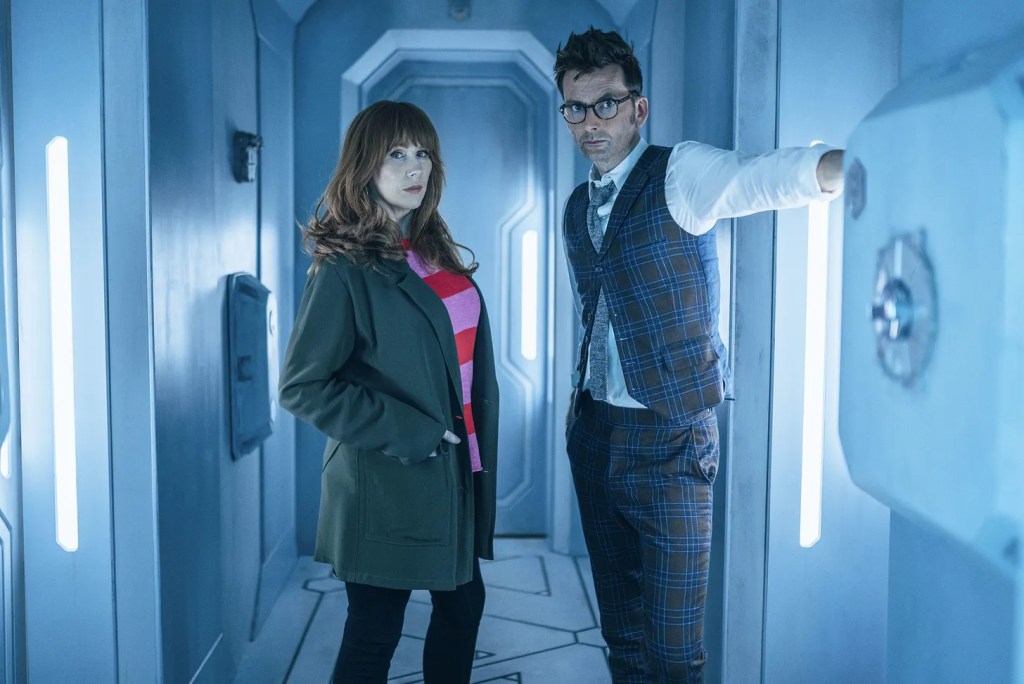
Wild Blue Yonder just lets the Doctor and Donna be together (and apart), it just lets Tennant and Tate act (with each other and themselves). Frankly, it has been YEARS since we saw such a rich and developed relationship between a Doctor and their companion. Moments that I liked included:
- The way they laugh about Donna’s music teacher, Mrs Bean, who has a surname named after a vegetable.
- They discuss how Newton is hot and the Doctor notices a change in his feelings.
- The moment where the Doctor and Donna argue about the TARDIS disappearing, only to realise what they are doing and stop, which lets Donna’s fears about not seeing her family again come to the surface and then the Doctor acts to reassure her. The Fourteenth Doctor is emotionally available now.
- The Thunderbirds ‘bit’ when they get into the hover cart. (“Your car, milady.” “Thank you, Parker.”)
- The bit where the Doctor licks something and then feigns being poisoned just to wind up Donna for a few seconds.
- The anguish and distress they display when they get separated from each other on the spaceship.
- The way they bounce ideas and questions off each to figure out what’s going on here.
Honestly, you could make these two read the phone book out to each other for an hour and I’d just be utterly mesmerised.
The Not-Doctor and Not-Donna
“Darker… not scary – it’s genuinely weird” – Russell T Davies
I expected there would be something strange and weird about this episode. Theories were rife online as to what the secrecy was all about. Would there be a massive twist? Personally, I thought there would be some sort of simple yet high-concept idea and that once we knew what this was then the entire story would fall into place. And so in a very general sense, I was right.
The so-called Not-Things are entities from outside the universe who assimilate and feed off the appearance and memories of those lifeforms around them.
The scenes where they are introduced in the Orange/Blue rooms was creepy and effective. I didn’t actually clock the weird way that Tennant sits down on the first viewing but the unsettling way in which the scenes cut back and forth helped me realise what was going on. A second viewing made me realise how many clues were hiding in plain sight. It’s in the dialogue, and the performances, and the directing and the editing; all of them working harmoniously to deliver the same dramatic point. It is highly coherent television.
“My arms are too long” is here trying to be the new “Are you my mummy?”
The way they struggle with size and proportions whilst mimicking the forms of the Doctor and Donna is both quite funny and deeply weird. I’m still thinking about the line “Oh, I see! When something is gone, it keeps existing.” They are baffled by things we just intuitively understand. It’s not just the actors and production that have been stretched here. So have the monsters!
The chase sequence in the corridor was exhilarating and utterly mad. The way the Not-Things just become charging beasts and grow to an extraordinary size, so much that they get stuck within the corridor itself. There’s enough logic on screen to help you believe in the events but enough mystery left to make you wonder who are these creatures and why do they function in such a way?
This isn’t so much a horror story and a weird piece of high-concept science fiction, and that tallies with Russell’s promotional quote above. It is deeply weird and that’s my kind of thing.
Is this story actually a commentary on Artificial Intelligence? The way it feeds off images and text and then tries to assemble something that can pass for the work/form of a human? It certainly belongs in the Uncanny Valley. It could be read as a cautionary tale.
Continuity Revisitations
There were several moments that either referenced or captured the feel of past-Who stories:
- The way the Not-Things struggled with their humanoid forms and then stretched all-manner of body parts was reminiscent of the Gangers in The Rebel Flesh/The Almost People.
- The Not Things as a mysterious entity with the ability to mimic other life forms deeply feels like an expansion and continuation of the ideas within the brilliant yet hastily assembled Midnight.
- The way the Doctor struggled to understand and comprehend them could be seen as a parallel to the Boneless in Flatline.
- The intense focus on the lead characters being confined within a high concept bottle episode of course feels like Heaven Sent.
- The discovery of the deceased Captain floating around the hull of the spaceship felt very reminiscent of the moment when Scooti is discovered in outer space in The Impossible Planet. The theme of being on the edge of understanding also felt reminiscent of The Satan Pit.
- The Fourteenth Doctor, perhaps to some fan surprise, references the events of Flux and The Timeless Children, when discussing with Not-Donna where he’s really from. I felt that RTD has managed to derive some good character beats out of this and I genuinely feel he might return to this as a character/emotional beat in future series; it is something that is worth exploring. Personally, I was never against the ideas themselves but was not satisfied with the delivery or follow-up on them within the programme. RTD is welcome to take on whatever potential he sees within these ideas.
- It’s a story about a spaceship stuck on the edge of the universe and filmed largely using green-screen technology, of course it’s a homage to Underworld!!
The Climax
“Fenslaw, Collis, Brate…” was a countdown. People must have spent hours on the internet trying to interpret the meaning of these words in Doctor Who Magazine. Good for them.
The Doctor using his floating TARDIS like a skateboard is cool and I have no comments.
The scene where the Doctor picks out the wrong Donna seemed a bit off. I would have thought she might fight her way in. But the moment when the sounds drops off and Tate is left to stare at the oncoming explosion was a mighty fine bit of acting. Watching Non-Donna slide back out the TARDIS was a punch-in-the-air moment of satisfaction. Mathematical measurements save the day!
The final scene where the Doctor and Donna don’t discuss the Doctor’s newfound origins is quite sad; it feels like the Doctor has closed back up again after letting out his feelings to the Not-Donna. He’s not as immature and closed off as the Tenth Doctor though. So much progress made, and yet so much further to go.
Jimbo
OH MY GOD.
LOOK AT HIM.
He’s such A Little Guy.
I want him on my desk.
I want him on my keychain.
I want him to press the self-destruct button that ends my life.
10/10 robot.
I will go back and save you Jimbo.
Wilfred Mott
Wasn’t it really lovely to see Bernard Cribbins at the end of all that?
There he was, in one last scene, displaying all sorts of emotions at seeing Donna and then the Doctor once again.
It’s just nice to know that Wilf gets to see Donna with all her memories back and she feels happy with herself once again.
He hasn’t gone anywhere really. He’s just retired to his UNIT-funded cottage, like the old soldier that he is. Bless that man.
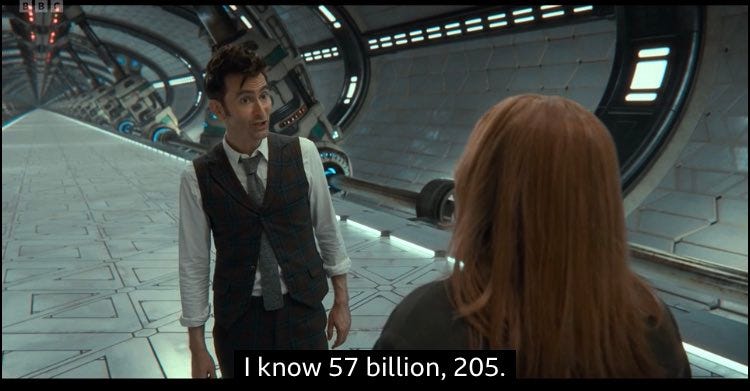
The Number 57

 The Brain of Möbius
Leave a comment