
It is a truth acknowledged across the universe that there are only two certainties in life: death and taxes. And yet The Sun Makers (1978) is the only Doctor Who serial to have both of them in spades. So with the HMRC Self-Assessment tax return deadline for the 2023-24 financial year looming large for the self-employed (you’ve got two weeks from the publication date!), I thought it might be fun – yes, FUN – to identify and explain every financial joke that I can spot within The Sun Makers, because learning is itself a form of earning. All praise the Company!
Episode One
“Compassion is a noble thing, Citizen. Also costly. A hundred and seventeen talmars.”
The currency used within the human colony on Pluto is the Talmar. Lewis Baston, author of The Black Archive #60: The Sun Makers, suggests that this word “may be a descendant of the Thaler” or the Taler, a silver mint coin used in territories of the Holy Roman Empire, and the root word for ‘dollar’. Robert Holmes, the author, also had a penchant for inventing alien currencies such as the blue credit bars in Carnival of Monsters, the 20-narg note in The Two Doctors and Grotzits in The Mysterious Planet (The Trial of Time Lord Parts 1 – 4).
“Four mercy attendants is now a further eighteen talmars. Disposal fee ten talmars plus of course an ad valorum tax of ten percent. Total one hundred and thirty two talmars.”
Of course, an ‘ad valorem’ (Latin: ‘according to value’) tax is one that is imposed at the point of sale. The main examples of this type of tax within the UK are VAT (Value Added Tax, currently set to 20%) when purchasing goods or services and stamp duty when purchasing a house. When purchasing something as expensive as a home, it really can feel like a kick in the teeth when you discover an ad valorem tax that you weren’t anticipating.
“I couldn’t meet my father’s death taxes. It was more than I was told…”
Death taxes or ‘Death Duty’ are nicknames for Inheritance Tax (IHT), a tax on the estate of someone who has just died, including all of their property, possessions and money. It was previously known by the more financially transparent term Capital Transfer Tax (i.e. a tax incurred when capital is transferred from one party to another). The workers on Pluto are forced to work until they die in order to pay off their taxes; they’re literally taxed to death!
“Pluto’s a lifeless rock.”
At the time of broadcast, Pluto was considered to be the ninth planet of our Solar System but has since been reclassified as a (dwarf) planet run. Pluto is also another name for the Greek God of the Underworld, Hades (Note that one of the primary antagonists is called Gatherer Hade!). Therefore its selection as the story’s setting by Holmes appears, not only to be a play on the term ‘plutocrats’, the riche and wealthy people who are running the colony, but also a joke on how the colonists exist on the boundary between life and death. Moreover, looking outside the fiction of the story, there’s also a certain irony that this story is partially filmed on the roof of a tobacco factory in Bristol given that tobacco factories were a key source for both death and taxes within the UK of the 1970s.
“It’s the taxes. I can’t pay the taxes.”
“Oh, the taxes. My dear old thing, all you need is a wily accountant.”
This line is a cheeky reference to the concept of creative accounting, the practice of deviating from the spirit of financial in order to present your accounts in a much more favourable light. This can range from legal but frowned upon practices such as tax avoidance to the most definitely illegal practice of financial fraud. At the time of recording The Sun Makers, the Doctor Who production team had its own wily accountant in the form of John Nathan-Turner, whose greatest financial success was balancing the budgets such that they were able to film in Paris for City of Death around two years later, the show’s first overseas location filming.
“You see, the Company charges fifty percent compound interest on unpaid taxes.”
Compound interest is simply the concept that you can earn interest on your previously accumulated interest, not just the original amount invested or borrowed. It is reported that Albert Einstein once said that “Compound interest is the eighth wonder of the world. He who understands it, earns it … he who doesn’t … pays it.” It is brilliant if you are getting it on your savings and terrible if you are getting it on your loans.
The power of compound interest can be illustrated using a basic financial example: suppose I invested a 1000 talmars in a savings account on Megropolis One for a period of 25 years. If the savings account paid a simple rate of interest of 5% each year for 25 years, then I would ultimately earn 2250 talmars. However, if I was paid a compound rate of interest of 5% each year for 25 years, then I would ultimately earn 3386.35 talmars. That’s an extra 1136.35 talmars for no extra work! If you’d like to understand more on the experience of paying unrealistic amounts of compound interest, please see the Student Loans Company.
“He can’t make ends meet. Probably too many economists in the government.”
“These taxes, they are like sacrifices to tribal gods?”
“Well, roughly speaking, but paying tax is more painful.”
The reason why this exchange is funny is because it just is. The Doctor, Leela and Cordo then promptly run away from Gatherer Hade. They’re literally running from the tax man.
“It’s turning into subway CT1.”
We see K-9 travelling along Subway CT1, which is a reference to the Corporation Tax (hence CT) form of the same name. It has absolutely nothing to do with Issue 1 of Celestial Toyroom, aka CT1, the official fanzine of The Doctor Who Appreciation Society.
“Here’s a ConSumCard we got of an Ajack. It’s made out for a thousand talmars.”
The ‘Consumcard’ is a blatant parody of the first ever banking card, the Barclaycard. It’s quite amusing to compare the visual similarities when you put the two side-by-side. Producer Graham Williams was rather worried this would be viewed as product promotion by the BBC rather than satirical commentary and so the finished product is not as egregious a parody as originally intended.
“I must go to the Company palace and warn the Collector. We need the Inner Retinue to deal with this.”
Here, Inner Retinue is a bit of wordplay on Inland Revenue, the tax-raising branch of the UK government in 1977. The department ceased to exist as of April 2005 when it was merged with HM Customs and Excise to form the present-day entity HM Revenue & Customs (HMRC).
“Tens, please.”
For the episode one cliffhanger, we see a cashpoint that gases the Doctor into an unconscious state. Given that the Doctor is attempting to commit fraud using an ATM, it’s remarkable to think that Williams wasn’t worried about the Doctor promoting financial crime to the young, impressionable audience. The Doctor is eventually successful at extracting money from a cashpoint during the 2006 Christmas Special, The Runaway Bride.
Episode Two
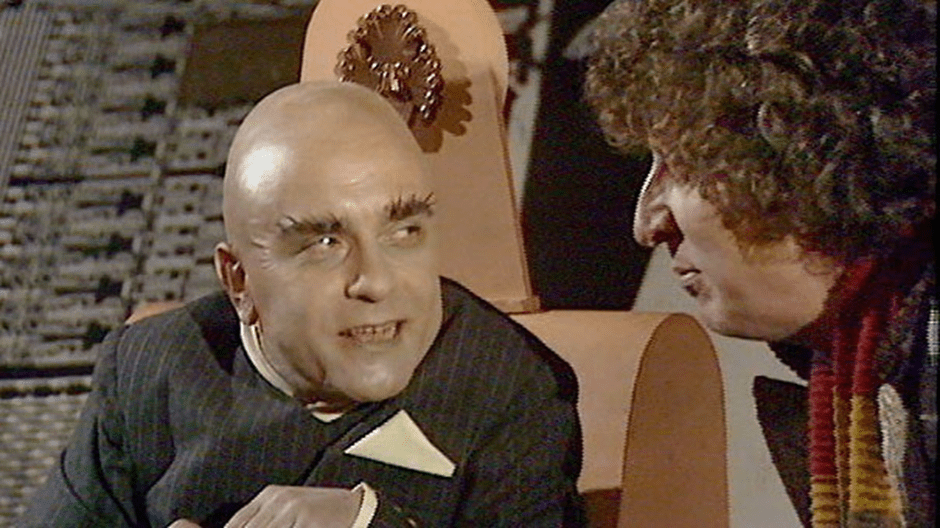
Keen followers of 1970s UK politics, or indeed the old fans, might have spotted that The Collector has similar eyebrows to those of Lord Denis Healey, a former Chancellor the Exchequer. The Chancellor is generally considered to be the most senior politician within the UK Government after the Prime Minister and is responsible for managing the UK economy. Healey held the position from March 1974 to May 1979 and so was the incumbent Chancellor when this story was written, produced and broadcast.
“I was an executive grade at the chemical plant in charge of PCM production. I got curious about some of the other products”
Within the fiction of the story, PCM stands for PentoCyleinicMethylhydrane. I’ve only studied Chemistry up to A-Level but I’m fairly sure it’s made-up, although it sounds suitably like an organic compound. Bringing things back to financial matters, I also think this acronym is a play on the term ‘per calendar month’ as seen on many-a-set of accounts. This is also the only point within this article that is not mentioned in some form within the DVD text commentary for The Sun Makers written by James Cooray Smith. Look Jim – new fact!
“An ongoing insurrectionary situation would not be acceptable to my management. This fiscal period we’re aiming for a seven percent increase in the gross planetary product.”
Gross Planetary Product is clearly a play on the financial term Gross Domestic Product (GDP), which measures the monetary value of all final goods and services within a country over a specified time period. Since we are talking about an entire planet here, a change in the financial vocabulary is logically necessary.
“To err is computer.”
“To forgive is fine?”
“To err is human, to forgive divine.” – Alexander Pope, An Essay on Criticism
Whilst not especially financial-related, the reason I find this bit quite funny is knowing that a computer only does exactly what a human tells it to do, and this is a common root cause to any issues that occur in the day-to-day running of a financial entity such as bank or insurance company. Now whether the human knows what it is telling the computer in the first place; that’s an entirely separate matter!
“I formed the plan on my way back from the Palace. I call it Morton’s Fork, in honour of one of my illustrious predecessors.”
Morton’s fork is a historic reference to a ‘catch-22’ argument devised by John Morton, the Archbishop of Canterbury and Lord Chancellor under King Henry VII. Morton argued that a man living frugally must have money to spare and so would be able to pay taxes, and that a man living opulently must be rich and so would also be able to pay taxes. King Henry VII stabilised the government’s finances by introducing several new taxes during his reign. However, after his death a commission found widespread abuses in the tax collection process. No wonder Gatherer Hade admires these two so much!
“If we take the P45 return route they’ll never expect to find us there.”
Corridor P45 is a reference to the P45 form; it must be issued by an employer when an individual stops working for them. Receiving your P45 is now a common slang term for unemployment. At the cliffhanger of episode two, Leela manages to put herself at risk of being terminated by the Company despite not being employed by them.
Episode Three
“But I think it could work. And what have we got to lose?”
“Only your claims.”
Claims here meaning tax claims. This is, of course, a more financial take on The Communist Manifesto written by Karl Marx and Friedrich Engels, which states that workers have ‘nothing to lose but their chains.’
“Time Lords. Oligarchic rulers of the planet Gallifrey. The planet was classified grade three in the last market survey, its potential for market development being correspondingly low.”
It’s amusing to note that Gallifrey is considered to be a much more technologically advanced civilisation than Earth and yet here we learn it does not attract the interest of capitalists. The Doctor finds Gallifrey ‘boring’ and in a slightly different sense so too does the Collector. But the Doctor has never really cared for money anyway.
“This Doctor could be a problem.”
“In what way, your Voluminousness?”
“He has a long history of violence and of economic subversion. He will not be sympathetic to my Company’s business methods.”
Violence and economic subversion would likely introduce increased volatility and instability within the financial markets, so naturally the Collector would not take kindly to such an individual. But unfortunately for him it would seem that the Doctor likes to instigate a revolution every now and again.
“I mean, who runs it? What’s it for?”
“It makes a profit, that’s what it’s for.”
I think this exchange hits a little harder in the present day given that some outspoken billionaires (you know them, I know them) appear to believe that the purpose of companies is to generate a profit for shareholders. It isn’t. Generating a profit is actually a goal of most business (would the Collector struggle to believe that some companies are happy just to break even?). Companies have to decide what the purpose of their business is and they should have a responsibility to achieve this in an ethically responsible manner. But then again, some companies just pour untreated sewage into the ocean, so what do I know?
“This is the moment I get a real feeling of job satisfaction.”
Yes, there really are people out there who get a sense of fulfilment making the numbers work towards their stated goals. I have seen them.
Episode Four
“A complete waste of time. And we’ve lost point oh four seven percent in production. Unpaid overtime to be introduced immediately for all work grades. See to it!”
What a way to incentivise the workforce! Unpaid overtime! Oh won’t someone think of the Company’s profitability??
“Yes, we’ll never pay breathing tax to the Company again.”
…
“Like the imposition of a double vision tax on people with more than one eye.”
Both of these lines make reference to ridiculous taxes that would be incurred by simply existing as a human breathing. We’re typically born having two eyes and we all need to breathe. It’s reminiscent of other ridiculous taxes that have occurred throughout history such as taxing windows, clocks, dice and even beards.
“You’ve mishandled the situation, Hade. As for your ambition to become Tax Master General. After this, forget it!”
A play on Paymaster General, a ministerial position within the UK Cabinet Office.
“I’m not the auditor, I’m the Doctor!”
Auditors are people responsible for independently checking and verifying the financial accounts and records of companies. However, a company may leave its financial accounts unchanged in the event of an adverse finding by the Chief Auditor, though their opinion must be presented verbatim at the start of the financial accounts.
“You are acquainted with our species?”
“Oh yes, oh yes. The Usurians are listed in Professor Thripsted’s Flora and Fauna of the Universe under poisonous fungi.”
Holmes almost certainly named the Usurians after the financial term ‘usury’, which is the practice of lending money at unreasonably high rates of interest. The Usurians then are essentially intergalactic loan sharks. But not actual sharks, that would be the Selachians.
“A normal business operation. The Company was looking for property in this sector, Earth was running down, it’s people dying. We made a deal.”
We know the Company are dead serious about financial success because they are in the business of real estate! Mark Twain once quipped ‘Buy land, they’re not making it anymore.’ An excellent illustration of how the power of real estate drives capitalistic expansion can be seen in this scene from The Founder (2016). It’s well worth a watch!
“There is nowhere else that is economic. This branch will close.”
…
“You blood-sucking leech! You won’t stop until you own the entire galaxy, will you. Don’t you think commercial imperialism is as bad as military conquest?”
“We have tried war, but the use of economic power is far more effective.”
Black Archive scribe Lewis Baston draws a direct comparison between the Company within the story and the East India Company (EIC) as a force of commercial imperialism. The EIC used economic power to gain control of Hong Kong and large parts of India. The company was ultimately dissolved in 1874 under the terms of the East India Stock Dividend Redemption Act. Money is the root of all evil after all.
“Negative surplus. Inflationary spiral uncheckable. Negative growth! This branch is no longer viable. We are bankrupt. Business failure. Closure imperative. Cut losses. Liquidate. Immediate liquidation.”
And with that, the Company is closed for business. Personally, I like to think that the liquidated form of the Collector exists within an insolvent solution.
Could we expect a dramatic return for the Collector to return as the “God of Taxes” in the Pantheon of Discord? It seems unlikely… All praise the Company!
Next month: All aboard the ‘Hyp’ Train!


 The Brain of Möbius
Leave a comment