Chris Chibnall likes maths. Like a lot. Putting maths into a Doctor Who script once was never enough for Chris. How gratifying then to find that he has done so three times over.
Firstly in 2007, we had his debut story, 42, the first Doctor Who episode title to consist solely of a number, in which we had a challenging pub quiz question about a sequence of happy prime numbers. Then in 2013, we had his fifth episode, The Power of Three, the first Doctor Who episode title to be a maths pun, in which we had a mysterious invasion of cubes all over planet Earth. These two episodes bookend Chris Chibnall’s contributions to Doctor Who under prior showrunners Russell T Davies and Steven Moffat.
In 2018, Chibnall became the showrunner of Doctor Who, casting Jodie Whittaker as the show’s first female lead and bringing Mandip Gill, Tosin Cole and Bradley Walsh aboard the TARDIS in the form of newfound companions Yaz, Ryan and Graham. Series 11 represented a fresh start for the show, a clean break if you will, allowing first-time viewers to join the show without feeling like they need to have seen any episodes from the previous ten series. But nevertheless, Chris’s penchant for throwing the odd mathematical bone into his Doctor Who scripts remained.
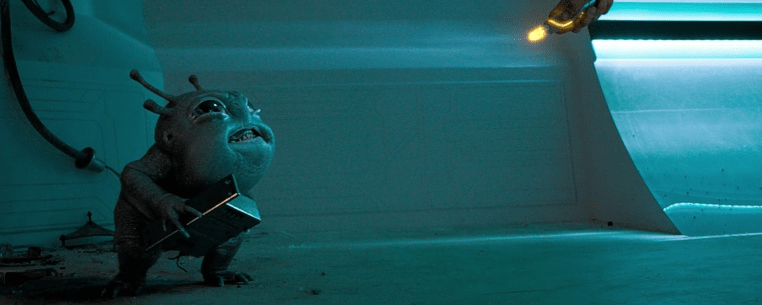
The Tsuranga Conundrum was originally meant to be the first episode of Series 11 not to have been written by Chris Chibnall, with Tim Price originally down to write the script. Price is a Welsh screenwriter who has previously written for several popular TV shows targeted at a wide range of audiences including Casualty (1986-), Secret Diary of a Call Girl (2007-11) and The New Worst Witch (2005-07). He had even previously written for Jodie Whittaker in the Sky1 firefighting drama, The Smoke. But alas, for whatever circumstances that transpired behind-the-scenes, he ended up receiving just an on-screen credit for creating the episode’s cute-yet-destructive monster, the Pting. This left Chibnall with a further script to write for his debut series as showrunner. Had things gone to the original plan, it’s entirely possible that this blog post probably wouldn’t exist.
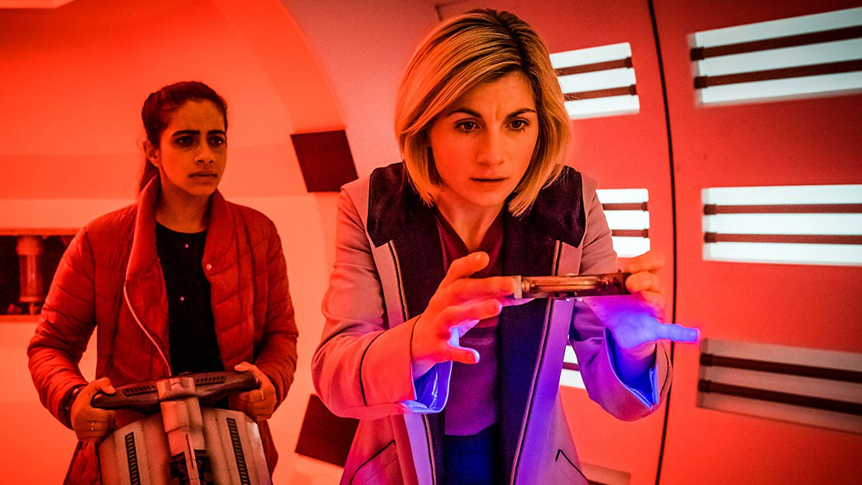
Now in the climatic moments of The Tsuranga Conundrum, the Doctor and Yaz plant a bomb in an escape pod as part of a trap for the Pting, who has been menacing them throughout the episode by eating various parts of the spaceship. It’s at this point that the Doctor decides to utilise Yaz for a bit of RNG (Random Number Generation).
DOCTOR: Pick a number between 1 and 100.
YASMIN: Fifty-one.
DOCTOR: Pentagonal number. Interesting.
(She sonics the bomb and then moves away from it.)
DOCTOR: Get in that corner.
YASMIN: What was the number for?
DOCTOR: Number of seconds before the bomb goes off. I moved it forward a bit.
YASMIN: What? I would’ve gone higher!
Humans are not particularly random when it comes to picking a random number; some numbers are just far more likely to be chosen than others. A reddit user once asked people to pick a random number between 1 and 100. After receiving thousands of responses, the top three were 7, 77 and 69 (in third, second and first place respectively). People seem to have a fascination with the number 7 as ‘the most random number’ (and indeed, slightly less people appear to have a puerile sense of humour).
It makes a bit more sense when you think about the psychology of choosing a ‘random’ number between 1 and 10. If someone asks you to draw a raffle ticket from a bowl, you’re not going to pick a ticket right off the top and probably not one right at the bottom. Instead, you’ll give it a good shuffle and pick one out in the middle of the pile. So with that in mind, you’ll probably won’t pick one to three or eight to ten. But equally, to don’t want to pick the number exactly halfway, five, as that also seems too obvious. You’re also more likely to think that odd numbers are more ‘random’ than even numbers, so that throws out four and six, leaving you with seven as your apparently ‘random’ selection.
In The Tsuranga Conundrum, Yaz has followed some of this number psychology. She hasn’t picked a number right at the very top or bottom of the range, and she hasn’t picked the number squarely in the middle, 50. She has also picked a number that is odd, rather than even. In addition to people tending to choose odd numbers rather than even numbers, people also tend to pick prime numbers rather than non-prime (or composite) numbers. [If you want a deep-dive into prime and composite numbers, check out my previous blog on Jago & Litefoot & Strax.]
51 isn’t prime though since 51 = 3 x 17. However, it does ‘look’ like a prime given that similar-looking numbers such as 11, 31, 41, 61 and 71 are all prime. The number 51 can then be considered a sort of Grothendieck prime, a number that sounds prime but isn’t. [Again, if you want more on Grothendieck primes, check out my previous blog on Russell T Davies and the number 57.] The Doctor subsequently remarks that 51 is a ‘pentagonal’ number, without any further elaboration, much to my frustration. I tend to find it rather frustrating when a new mathematical work is not defined!
Fan commentators have noted that various aspects of Series 11 appear to be Chibnall invoking the early days of the Hartnell era, in the sense that the Doctor has a triage of travelling companions and a series of adventures that alternate between sci-fi and historical in nature (ignoring any episodes set in the present day, like Arachnids in the UK). However, Chibnall doesn’t seem to be holding himself as strictly to the ‘educating the kids’ as evidence by his lack of a definition for what pentagonal numbers actually are. But then again, in his defence, they are a little tricky to explain without grinding the story to a complete halt. With that in mind, let’s start with a simpler group: the triangular numbers.
Triangular numbers are the number of dots needed to make an equilateral triangle of increasing side length. A triangle with no sides is just a single point, one dot. A triangle with side length of one has three dots. A triangle with a side length of two has six dots, a dot on each corner with a further dot within each side, and so the pattern continues.
Alternatively, you might think of it as adding rows of dots for each counting number. The first triangle has a row of just one dot. The second triangle adds a row of two dots underneath the first row. The third triangle adds a row of three dots underneath the first two rows, and so on. Look, I’ve even borrowed a handy diagram from a well-known online encyclopaedia to illustrate it for you.

So we have the first six triangular numbers: 1, 3, 6, 10, 15 and 21.
We can now extend this to other shapes.
The square numbers are similarly the number of dots needed to make a square of increasing side length. A square with no sides is again just a single point, one dot. A square with side length of one has four dots. A square with a side length of two has nine dots, a dot on each corner with a further dot within each side and one more in the centre, and so the pattern continues. And so we have the first six square numbers: 1, 4, 9, 16, 25 and 36. [But you should already know this, we covered squares and cubes in a previous Chibnall blog!]
At last, we get to pentagonal numbers. These can be calculated by working out the number of dots needed to make a pentagon with increasing side length… or you could just use the general formula. The nth pentagonal number is equal to (3n2 – n)/2. Yeah, I know, not the simplest formula, but it’s the cold hard truth. And so, from this, we have the first six pentagonal numbers: 1, 5, 12, 22, 35 and 51.
If that’s been a complete jumble of words to you, why not stare at the diagram below until it finally makes some sense to you.

All good now? You really sure? Okay then.
Having learnt all that maths, is there any thematic substance we can draw out of The Tsuranga Conundrum’suse of pentagonal numbers?
…
… … … … …
… … … … … … … … … … … …
Nope, sorry, I’m drawing a blank on that. But the point of maths isn’t just to learn things that have direct applications to the real world, sometimes we just learn things for fun and hopefully, with a bit of luck, they come in handy one day.
All I can manage to conclude is that it’s just yet another mathematical pun buried within a Chris Chibnall script: if you want a Pting gone, use a pentagon!
Next month: Watching Doctor Who, the wrong way round.

 The Brain of Möbius
Leave a comment