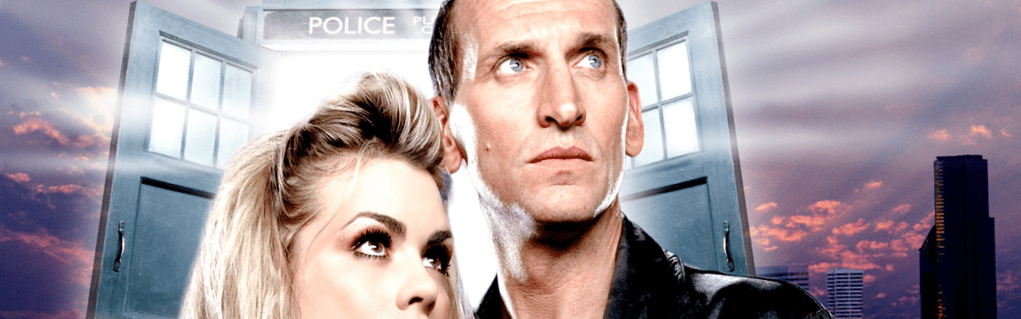
Last month, I wrote about my very first episode of Doctor Who, which was of course Dalek. I make an off-hand mention that my entire viewing experience of that particular series, generally known to Who fans as Series 1 (2005), was somewhat out-of-order. For a dyed-in-the-wool fan, it feels oddly fitting in retrospect that my introduction to Doctor Who was, without any deliberate intention, somewhat timey-wimey. So this month, to celebrate 20 years of that particular series of Doctor Who, I thought I’d take you through my timey-wimey journey with the Ninth Doctor and Rose. Or as the title says, we’re going the wrong way round.
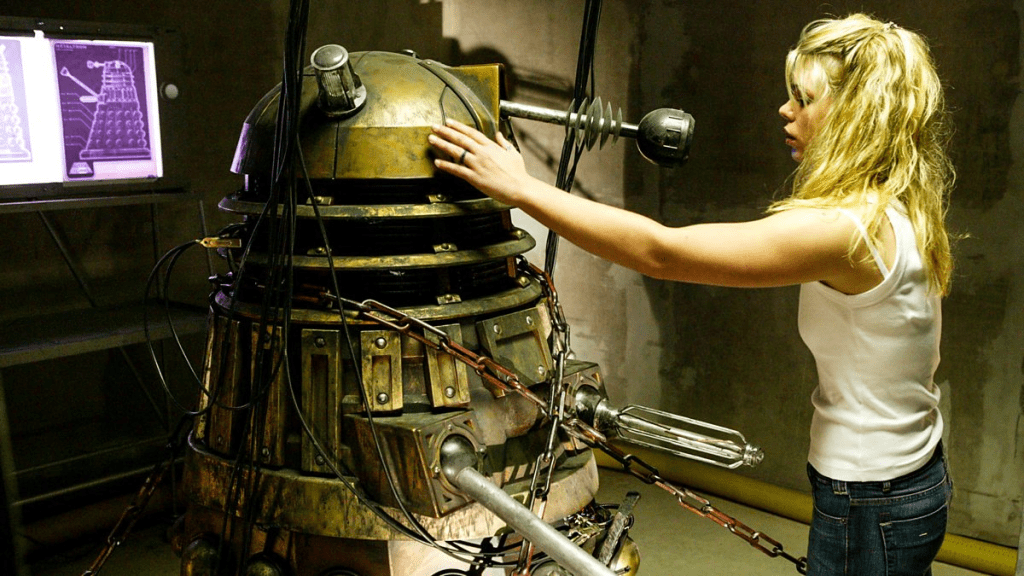
Dalek by Robert Shearman
Saturday 30th April 2005
As I’ve already covered last month, my first episode of Doctor Who wasn’t a live broadcast on a Saturday night. Instead, it was a video tape brought round to my house by a friend on a school night. Showrunner Russell T Davies has said that he intended this episode to work effectively as a second launch night, if for whatever reason the first five episodes did not go down well, but thankfully for him, that situation never came to happen. As I rewatched this episode on the big screen at the BFI Southbank back in early May, I still find it an engrossing piece of television. Everything I needed to know about this show was contained within this episode, and yet it also manages to tell a complete story on its own terms.
The opening shot of the TARDIS landing in the underground museum showed me how the TARDIS arrives in pretty much any adventure; it is now in my head that this is the quintessential way to start any Doctor Who story, even though that’s actually hardly ever the case in the 21st Century iteration of the show. It told me who the Doctor and Rose Tyler are, their friendship, their interest in their surroundings, their driving need to help others no matter who they are or what they might be. It told me that the Daleks were iconic and legendary villains that can cause untold devastation to the human race, even when there’s just a single one. And it told me about the Time War, that all-important bit of backstory that explains the Doctor’s trauma the disappearance of his species, the Time Lords, the Dalek’s lone survivor story and how Rose can help the Doctor move beyond his tragic past. It’s barely a few lines, but it tells us so much. Russell T Davies’s vision for the show is invariably at its best when he manages to tell us so much character and story using just a few lines.
I can recall writer Rob Shearman telling me some years ago that he’s had fans come up to him in the past saying thanks to him because ‘he was the one to make the show actually good again’. That they were saying to him the show wasn’t ‘proper’ Doctor Who for those first five weeks, with Russell’s burping bins and farting baby-faced aliens and that bit of skin that talks all sassy, and then he finally showed up and sorted it all out. And Rob would say to them something like, ‘well, it was still Russell’s show… and the episode’s story was his idea… oh, and he was the one who coached me through the entire bloody writing process, even when I had totally lost faith in the thing. But apart from that, I guess he didn’t really do anything!’
Fans, eh?
I was fortunate enough to speak to Rob again shortly after that BFI screening and he decided to give me a laundry list of self-critiques of his own episode, now that he had 20 years of hindsight. I suppose writers never stop re-writing their stories inside their heads, ever searching to make them as perfect as can be. But to me, it remains a piece of childhood magic that has managed to propel a 20-year-long interest in this silly blue box show, and that makes it perfect to me.
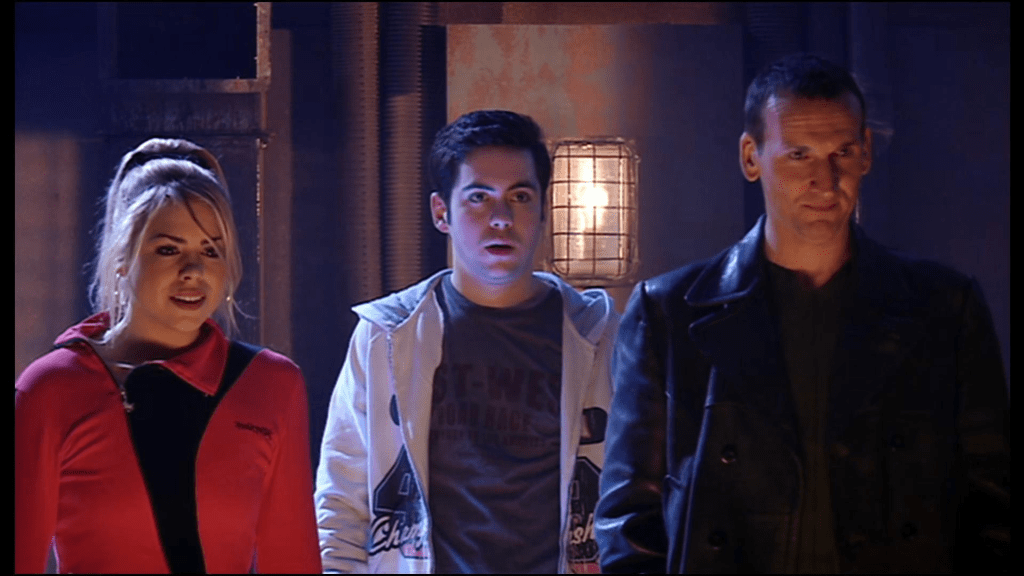
The Long Game by Russell T Davies
Saturday 7th May 2005
I had to wait nearly a whole week but, at last, Saturday arrived. And this time I could watch Doctor Who properly. By which I mean, of course, at around 7pm on a Saturday night, live on BBC1, in a living room somewhere within the United Kingdom. It’s just how things are meant to be.
The episode picks up almost immediately from the previous episode, with Rose, after taking some guidance from the Doctor, introducing Adam to a space station in the far future. I feel like part of the TARDIS crew; I’m truly on board with the show now. And then the titles start rolling.
People cite The Long Game as a contender for the ‘weakest link’ (hehe) of Series 1 but I still find it fairly good viewing. Simon Pegg as The Editor is the highlight of the show, and Adam’s hasty exit from the TARDIS is both awfully funny and thoroughly deserved. I watch the next time trailer and see that next week will see the TARDIS go back in time, meaning I get my first trip into the past, and it’s set in some far-off distant time period known as the 1980s.
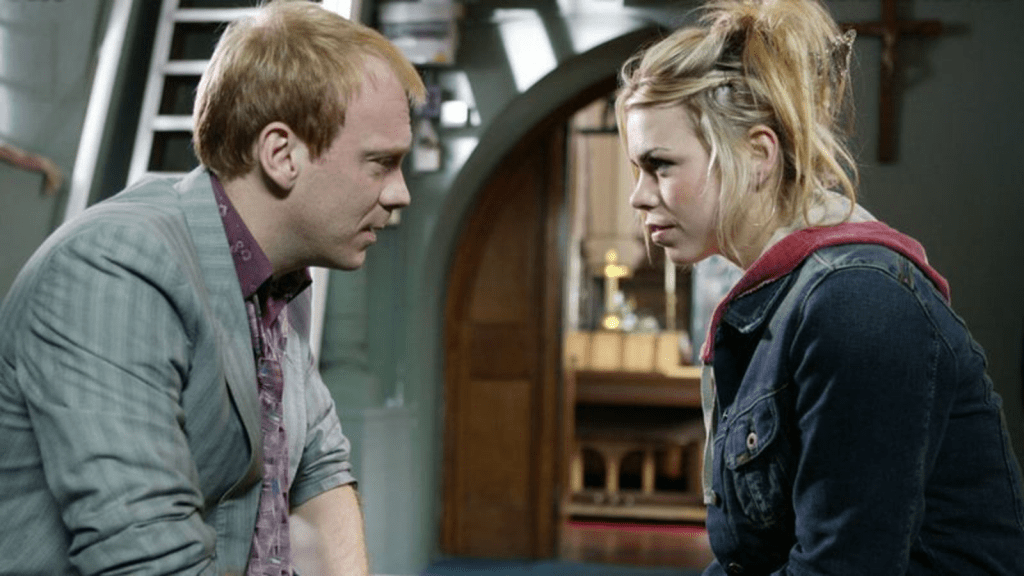
Father’s Day by Paul Cornell
Saturday 14th May 2005
I remember at some point in my late teenage years being more critical of this story because I felt the plot mechanics were too woolly, that this episode was not logical enough. But my current self and my nine-year-old self would disagree with this version of me, because this is a core Nu-Who story. It starts simple enough, Rose wants to see her father on the day he died, as a result of a hit-and-run car accident, so that she can be there for him. This is, as I’m sure you know, ultimately what happens, but the route taken to get there is by no means straightforward. What follows is a powerful drama about the importance of ordinary people and the decisions they make to try and keep their loved ones safe.
What has changed over the years is that nine-year old Evan thought the Doctor was totally right here, that Rose was stupid and selfish, that she should have followed the rules of time travel and not interfered to save her dad’s life, that the appearance of the Reapers was a form of retribution from the universe for her actions. But now, with two decades more life experience and having lost a few family members, albeit not a parent, I am much more sympathetic towards Rose. Of course she would take that chance, I think now. As I type this, I can hear the loud sobbing and sniffing of the audience at the BFI during the episode’s climax, when Pete Tyler says he has to go out of the church and get hit by the car, like he was always supposed to. His dad joke about ‘not being able to even die properly’ remains a funny but touching moment.
In a similar sense to Dalek, this feels like a quintessential Who story, one that explores a major idea of time travel: going back in time and changing your own past. Maybe the plot mechanics are still a bit woolly, but the drama on screen is so powerful that you barely have time to think about it. It’s an episode that’s focused squarely on making emotional sense. And unlike the Classic era, this episode goes hard on the emotional gamut, leaving you utterly devasted by its final obituary line.
The Empty Child/The Doctor Dances by Steven Moffat
Saturday 21st – 28th May 2005
This is it, my first Doctor Who cliffhanger! But I’m already getting ahead of myself.
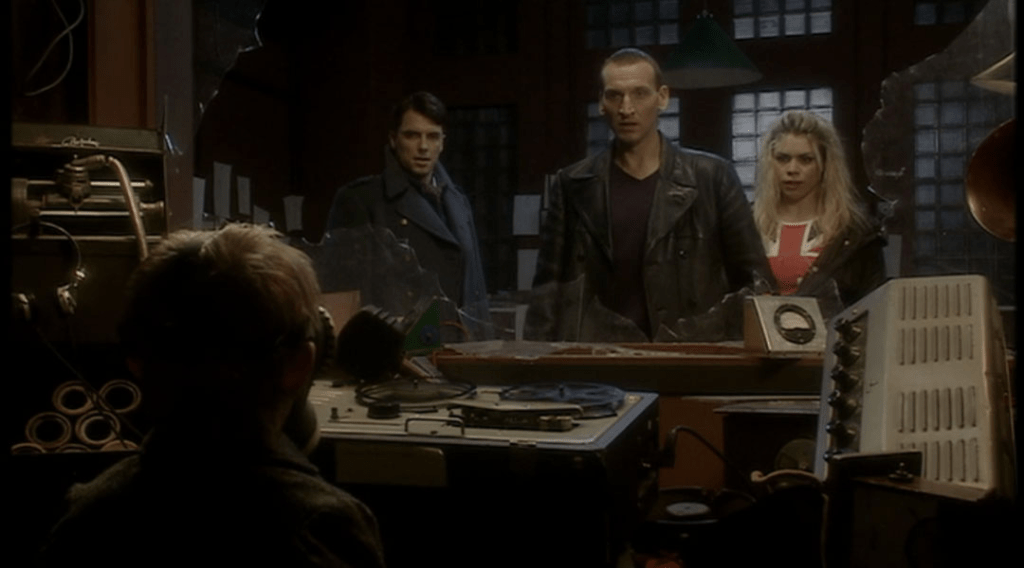
One thing that I love about the opening of this episode is that it starts with the TARDIS chasing an object through the space-time vortex. The Doctor says to Rose that it’s “about thirty seconds from the centre of London.” What then immediately follows is a title sequence, the same one I’ve already seen three times, of the TARDIS travelling through the time vortex, which is about thirty seconds long. And then, we see the TARDIS land, as promised, in the centre of London, during the 1940s Blitz. The way Steven Moffat uses the title sequence to continue the story in my nine-year old head, rather than as a momentary pause or interruption, is for me his first moment of brilliance writing for the show, and there’s plenty more of it within this same episode.
There’s a reason this episode caused such a buzz in the playground the following Monday. We all thought it was cool, and scary, and proper grown-up telly. Nobody wanted to play as Daleks in the playground that week, everyone was now a gas-mask zombie instead, each and every child endlessly droning “Are you my mummy?” I think the moment that was lodged in our collective minds was that moment where Dr Constantine coughs and coughs until the gas mask grows OUT OF HIS MOUTH and fuses itself to his face. Chilling stuff, but not so much that I couldn’t go to sleep that night. Perfect tea-time terror then.
Then there’s the cliffhanger. The Doctor, Rose and Captain Jack are completely surrounded by gas mask zombies. “How can they possibly get out of this,” I thought for an entire week. I could not wait to find out. And then the Doctor just sends them to their room, like an angry parent. And they all obeyed him. I did not see it coming, but it made perfect sense to a child like me. Genius stuff. Made even better when the Doctor discovers the Empty Child itself is behind him later on, because he *is* actually stood in his room. It remains snappily written and impeccably plotted, albeit at a slower pace to Moffat’s later contributions to the show, but that’s no bad thing.
And then, years later, as a student in my late teens, I come back to this episode and hear the line “Not sure if it’s Marxism in action or a West End musical.” I laugh in a way that my nine-year-old self would never even begin to understand.
Bad Wolf/The Parting of The Ways by Russell T Davies
Saturday 11th – 18th June 2005
Woah. Woah woah woah.
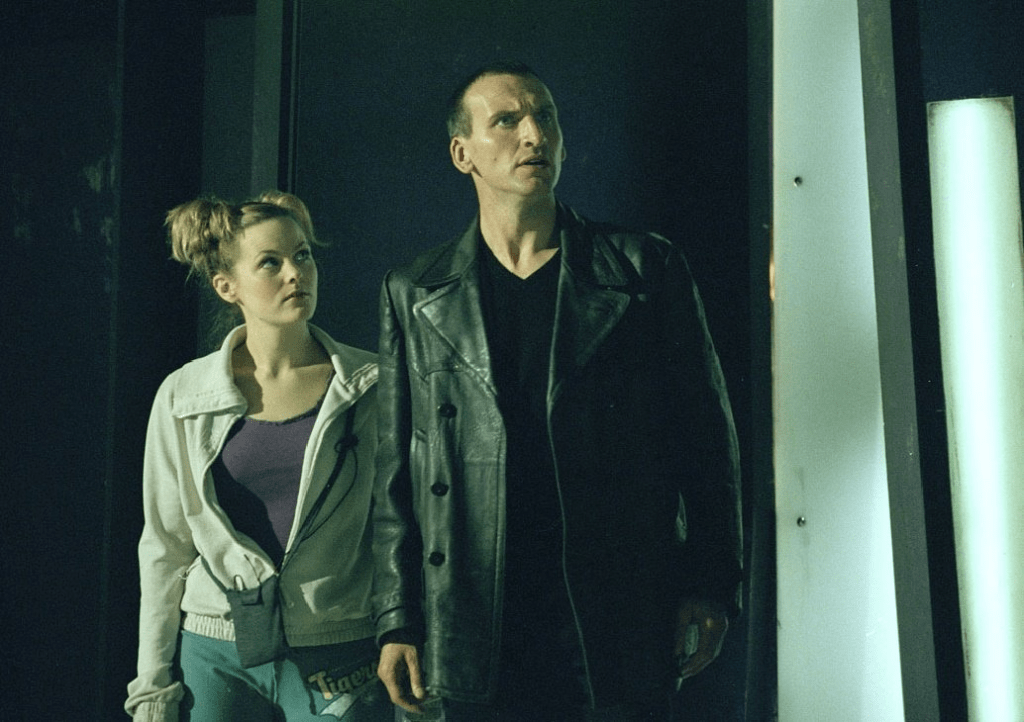
“What has happened here?” I hear you cry out. It’s simple really. The week after The Doctor Dances I went away on a primary school trip to the Forest of Dean. This meant I missed the live broadcast of Boom Town, but this turned out to be rather serendipitous for two big reasons.
One: this episode was a sequel to a story that I had not seen, due to starting from episode 6. So I would have been missing on some key context that other viewers would have had, such as who the Slitheen were, why they were there and what happened when Margeret Slitheen had previously encountered the Doctor and Rose. This meant that when I did finally get to watch Boom Town it was after Aliens of London/World War Three, as was intended.
Two: I did not see the next time trailer at the end of Boom Town. This meant I went into the episode without any prior knowledge or expectation as to what I was going to see. And what happened next blew my little nine-year-old mind.

 The Brain of Möbius
Leave a comment