
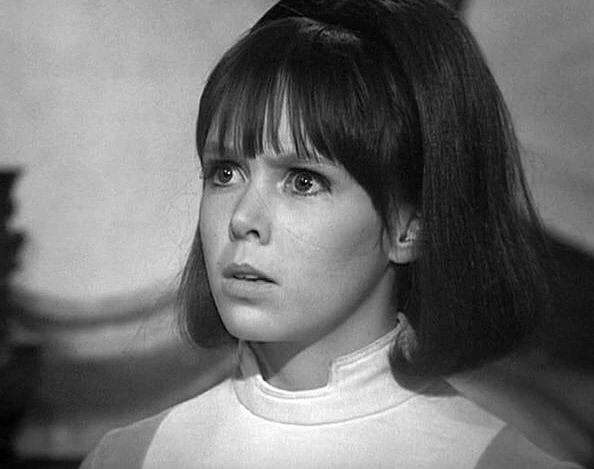
When Who fans talk about mathematicians in Doctor Who, they will inevitably mention Adric. And why wouldn’t they? He was a self-proclaimed mathematical genius, he wears a star-shaped badge for mathematical excellence, and he essentially died trying to solve a maths problem on a freighter ship that had been hijacked by the Cybermen. Of course, you would talk about Adric. But fans tend to overlook Zoe Heriot, portrayed by Wendy Padbury and the last new companion of the 1960s, who was equally characterised by her mathematical genius. Zoe was actually the *first* mathematical companion in Doctor Who.
(A few of you might dare to argue that Steven Taylor is really the first mathematical companion because of his mathematical knowledge as a space pilot – see The Cold Equations by Simon Guerrier, for example – but since he hasn’t specialised in the field mathematics in the same way that Adric and Zoe have, I don’t count this.)
Zoe introduces herself in Episode Three of The Wheel in Space by saying “I’m an astrophysicist. Pure mathematics major.” As a mathematician myself, I am struck by the juxtaposition of these two sentences. Because whilst both astrophysics and pure mathematics both contain, well, maths, the two areas could not be any further apart within the discipline of mathematics.
Astrophysics is a subdomain of physics that involves the study of planetary bodies and would involve substantial applied mathematics. such as the mechanics of celestial bodies. In contrast, pure mathematics is generally used to describe the study of mathematics devoid of any context or application, which includes areas such as analysis and number theory. As a viewer, it makes me ask why is Zoe working in an area of applied mathematics when she trained in the area of pure mathematics? Wouldn’t she prefer to work in an area more suited to her academic strengths? Maybe there’s a lack of employment opportunities for pure mathematicians in the year 2079?
We never get a proper justification for this characterisation, because that just wasn’t how Classic Who seemed to work. It gets a bit better in the 1970s when we see Sarah Jane Smith doing some journalism, or Tegan Jovanka making her journey to work as an air stewardess at Heathrow airport. But then again, we never see Peri Brown doing some botany or Mel Bush doing some computer programming (at least, not in her 20th Century episodes). So I feel that Zoe’s characterisation here is the product of a writer, in this case David Whittaker, who thinks this makes her seem smart without really understanding what he’s saying. Like how Bruce Banner, aka The Incredible Hulk, is said to be smart because he has seven PhDs – why would anyone pursue that many PhDs? A moment’s rational thought makes this sound not clever, but strange.
I haven’t had the chance to research this but I strongly suspect that Zoe’s characterisation as an astrophysicist was a product of Kit Pedler’s storyline for The Wheel in Space, from which David Whittaker wrote the script. Her mathematical genius only really comes into play once more during her tenure, at the climax of Episode 8 of The Invasion, also based on a storyline by Kit Pedler involving the Cybermen, but written by Derrick Sherwin instead. She also gets to use her genius to show-up the Doctor in the Robert Holmes-penned script The Krotons, which is a funny and clever bit of writing on Holmes’s part, but otherwise I feel it barely comes into play in her episodes which is a shame. Perhaps this lack of prominence in her general characterisation is why Adric is often better remembered than Zoe for their mathematical ability.
Nevertheless, I do think Zoe’s appearance on Doctor Who at that time was an important push in the right direction for more intelligent and proficient companions. The last time Kit Pedler was responsible for introducing a female companion was in the storyline of The War Machines, which introduced Polly Wright. She proves herself to be capable in many stories such as handling the Doctor’s regeneration over the course of The Tenth Planet and The Power of the Daleks a damn sight lot better than macho sailor Ben Jackson. She’s later supportive and resourceful to the Doctor during the events of The Moonbase, using nail varnish remover to dissolve the Cybermen’s plastic control panel.
After Zoe, we get Liz Shaw, the second female companion introduced under the oversight of script editor and then producer Derrick Sherwin. Liz is a scientist and researcher from the University of Cambridge with multiple doctorates and interdisciplinary qualifications. This is what makes her an ideal “all-rounder”, as the Brigadier puts it, to help assist UNIT with their investigations into extra-terrestrial matters. Again, we could level the – what I’m now dubbing – the ‘Bruce Banner doctorate critique’ at her, but at least she only has two doctorates, alongside some honorary ones, rather than seven of them. She also seems to be a sort of spiritual successor to the character of Ann Travers in The Web of Fear, Sherwin’s first story editor credit, in which she claps back at a bemused soldier “When I was a little girl I thought I’d like to be a scientist, so I became a scientist.”
Although Liz’s time on Doctor Who was somewhat cut short, she’s not the last of capable and educated female companions. We later get Sarah Jane Smith, an investigative journalist, Romana, a highly intelligent and academic Time Lord, Nyssa of Traken, who is shown to be knowledgeable about bioelectronics in Castrovalva, Peri Brown, who as previously mentioned is a botany student, and Melanie Bush, who as previously mentioned is a computer programmer. It would have arguably been better if these parts of their character played a greater role in some, or even all, of their storylines, but I think that shift in the default characterisation of such companions can be traced back to Zoe Heriot.
Now hurry up and announce the Season Six boxset, we need more Zoe Heriot!
Next Month: Another Underappreciated Female Mathematician

 The Brain of Möbius
Leave a comment