
“Real mathematics has no effect on war. No-one has yet discovered any warlike purpose to be served by the theory of numbers or relativity, and it seems very unlikely that anyone will do so for many years… But the ‘great game’ of chess is primarily psychological, a conflict between one trained intelligence and another.” – G. H. Hardy
Introduction
The Seventh Doctor likes to play games. Games on a cosmic scale. He likes to challenge opponents to games of strategy and them mix it in with the high-stakes winnings, a sort of combination of chess and poker. He’s not afraid to use real people as game pieces, including his closest friends and allies, and the outcome of his games will ultimately determine the fate of entire worlds. Well, he does like the sound of empires toppling. As the Doctor once said, quoting the former British Prime Minister Benjamin Disraeli, “Every great decision creates ripples…”.
There is no story that makes this clearer than 1989’s The Curse of Fenric, a story which sees him do battle once with an ancient and terrible evil known as Fenric. The Doctor challenges Fenric to solve a chess problem and his companion Ace gradually realises that the unfolding events are all part of a real-life chess game being played between them. A game within a game, if you will. One abstract representation contained within the other.
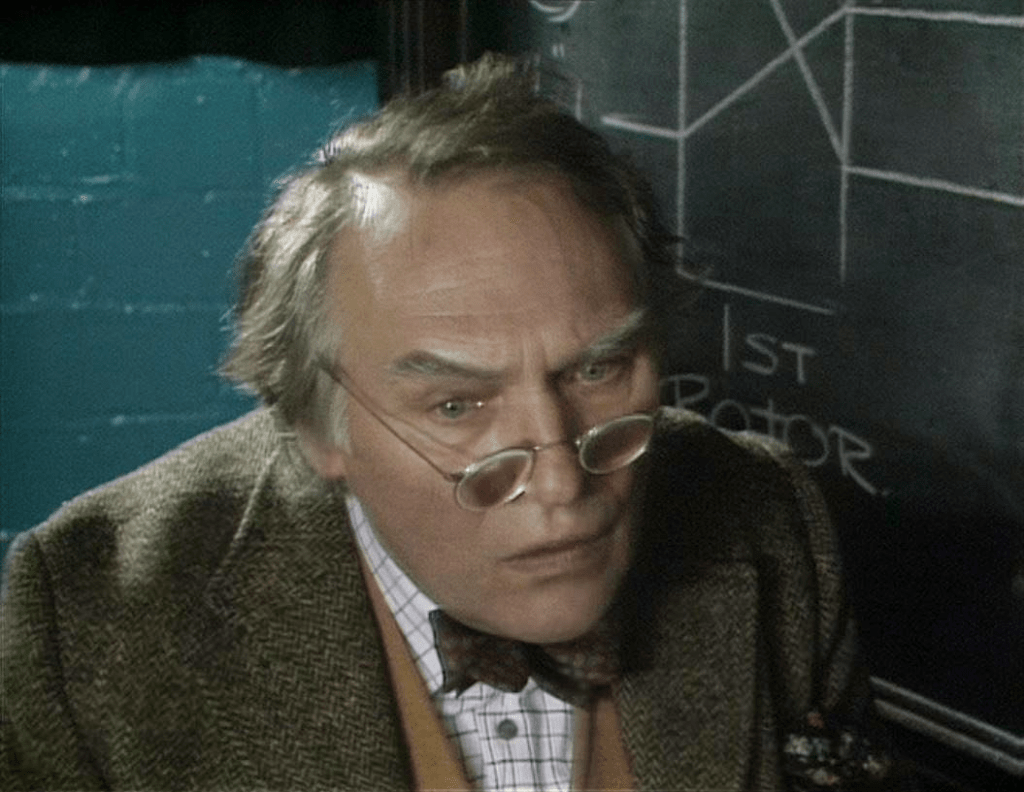
This story employs ideas from an area of mathematics known as ‘game theory.’ The serial explicitly invokes these ideas with the Doctor’s reference to the Prisoners’ Dilemma, one of the most well-known problems within game theory. We can even see a logic diagram for the Prisoners’ Dilemma on one of the blackboards in Dr. Judson’s offices. These ideas are never expanded upon within the serial, which is unsurprising given how much is already going on. We also know that the production team were pressed for time as it was when it came to the broadcast edit! However, these ideas of game theory and the Prisoners’ Dilemma have stronger thematic relevance to the story than fans may have realised. Moreover, these ideas are remarkably suited to a story set during the height of the Second World War.
The Mathematics of War
Mathematics had a considerable effect on bringing about the end of the Second World War in 1945. Not only had number theory been used by the cryptographers working at Bletchley Park to crack the Enigma Code, which was estimated to have shortened the war by around two years, but also the mathematics of general relativity assisted with the development and subsequent testing of the first atomic bomb, which was estimated to have shortened upto around 166,000 lives in Hiroshima.
Whilst Hardy, a highly regarded mathematician of his time, provides an emphatic defence about the pursuit of mathematical studies for its own sake in his essay A Mathematician’s Apology, his aforementioned quote is a fine example of Something That Has Aged Poorly. At times, his thoughts even stray into blatant misanthropy (“most people can do nothing at all well”) and I would consider such an attitude against the narrative ethos of Fenric,as well as Doctor Who more generally (e.g. “We’re all capable of the most incredible change”).
Hardy was known to detest the militaristic applications of mathematics and so did not play a considerable role in the efforts of the Second World War. But had he known about the highly secretive work of his contemporaries then he may have revised his earlier statement. One such contemporary was John Von Neumann, a Hungarian-born mathematician from a wealthy Jewish family who emigrated to America before the outbreak of the Second World War. Writer and journalist Alex Bellos describes Neumann as “the mathematician who shaped the modern world.” Whilst not a cryptographer like Alan Turing, he played a central role in the development of the modern computer, designing the fundamental internal architecture of the electronic device you are currently using to read this blog, as well as working on the Manhattan Project which developed the first nuclear bomb. He was also a central figure in the development of game theory.
Game theory is “an area of mathematics concerned with modelling how participants behave in situations of conflict and cooperation”6. Neumann coined the term ‘game theory’ himself in 1944 when he co-wrote the book The Theory of Games and Economic Behaviour. However, his ideas weren’t simply used for recreational purposes but to predict the behaviour of competitive market forces in economic scenarios as well as develop military strategies for US intelligence during the Cold War. As Simon Singh notes, generals were now “treating battles as complex games of chess.” This is precisely what the Doctor is up to in The Curse of Fenric when he arrives at the secret military base near Maiden’s Point.
But more than that, the story presents us with a dramatic representation of game theory in motion, set at the point in history when it first came into formal existence. Because in the year 1943, as the Doctor is masterminding a plan to prevent Fenric and the Ancient One detonating a set of devasting chemical bombs that will poison and pollute the entire world, Von Neumann is taking up his post on the Manhattan Project, pursuing the development of a weapon that will have similar consequences.
It’s perhaps unlikely that writer Ian Briggs had such a detailed knowledge of the history of mathematics, but nevertheless the inclusion of game theory in a story set at this exact point in history is extremely pertinent. As Una McCormack observes in her Black Archive, “The wartime setting of The Curse of Fenric is very far from being window dressing, and the moment in the war is crucial.”Neumann’s choice to apply his knowledge of mathematics to military warfare, in what can be read as an attempt to re-lay the global chessboard, creates the very future that we inhabit today. Just like in The Curse of Fenric, the history of the past continues to unfold within our present moment.
Zero-Sum Games and The Prisoners’ Dilemma
JUDSON: You’re familiar with the Prisoner’s Dilemma, then?
DOCTOR: Based on a false premise, don’t you think? Like all zero-sum games. But a neat algorithm nevertheless, Doctor Judson.
This quote gives us an insight to the Seventh Doctor’s moral philosophy here. He states that all zero games are based on a ‘false premise.’ Game theorists will assign a value, sometimes known as utility, to every possible outcome for each player in a game. A zero-sum game is one where if you add up all the utility values you get zero. This means that if one or more players gain some points then one or more different players must lose an equivalent number of points, with the sum total of points remaining constant. If you apply this idea to real-world contexts, it would suggest that there must always be winners and losers. The concept of a mutually beneficial outcome for all players doesn’t exist! There is significant research to suggest that people tend to have a cognitive bias towards zero-sum games. We intuitively believe that this is how the world works.
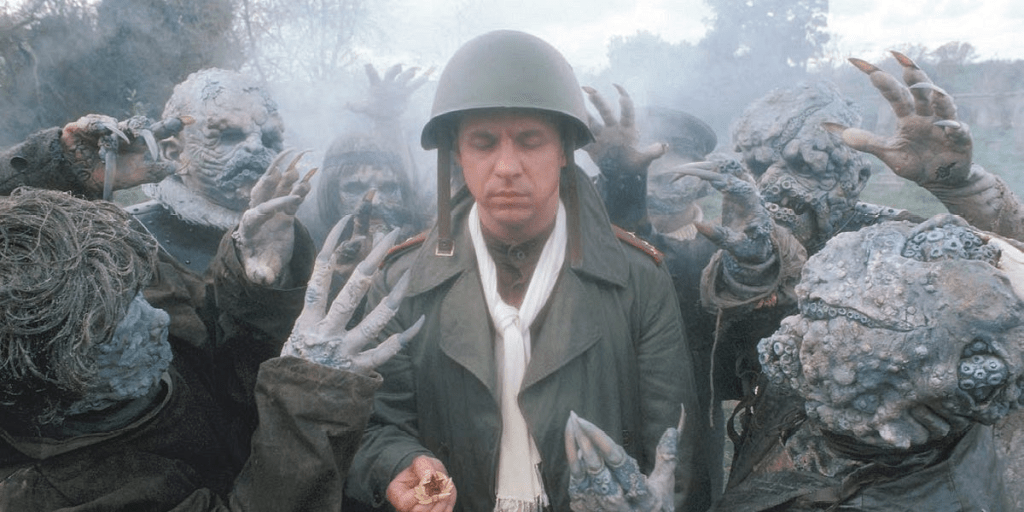
The Doctor, however, believes life more accurately reflects a non-zero-sum game, meaning that there exists at least one outcome where all the players can suceed, that it is possible to achieve mutually beneficial outcomes. This remark foreshadows the story’s conclusion where the British and Russian soldiers, Bates and Vershinn, join forces to fight the common enemy. This decision is a rejection by them of the ideology of zero-sum games as they embrace the possibility that both sides can win. Moreover, this is a rejection of Thatcher’s own political philosophy by the narrative, as is the case with every other story produced under the tenure of script editor Andrew Cartmel. It also managed to pre-empt Geoffrey Howe in his resignation speech in 1990 (“The European enterprise is not and should not be seen like that – as some kind of zero-sum game”).
What about the Prisoners’ Dilemma then? How does that fit in with all this? Here is the problem as formulised by Albert W. Tucker in 1950:
“Two members of a criminal gang are arrested and imprisoned. Each prisoner is in solitary confinement with no means of communicating with the other. The prosecutors lack sufficient evidence to convict the pair on the principal charge, but they have enough to convict both on a lesser charge. Simultaneously, the prosecutors offer each prisoner a bargain. Each prisoner is given the opportunity either to betray the other by testifying that the other committed the crime, or to cooperate with the other by remaining silent. The possible outcomes are:
- If A and B each betray the other, each of them serves two years in prison.
- If A betrays B but B remains silent, A will be set free and B will serve three years in prison.
- If A remains silent but B betrays A, A will serve three years in prison and B will be set free.
- If A and B both remain silent, both of them will serve only one year in prison (on the lesser charge).”
We can more easily refine the description of this problem with a pay-off matrix, a grid which shows all the values in an easy-to-read layout, like so:
| Criminal B remains silent | Criminal B betrays | |
| Criminal A remains silent | [1, 1] | [3, 0] |
| Criminal A betrays | [0, 3] | [2, 2] |
For each set of outcomes, the first number represents the jail term of criminal A and the second number represents the jail term of criminal B. So, for example, if A betrays and B remains silent, then A spends 0 years in prison whilst B spends 3 years in prison, just as its stated in the second bullet point above. It is also not a zero-sum game, allowing the two prisoners to decide whether they want to cooperate or compete with each other.
What outcome might we expect if we let the two criminals play the game? Well, one way that a game theorist might predict this is to investigate whether there is a dominant strategy here. A dominant strategy is an action that a criminal can take that will always provide the better outcome, regardless of what the other criminal chooses to do. We can see that such a strategy is present here.
If B expects A to remain silent, then they should choose to betray because they will spend zero years in prison instead of one. But if B expects A to betray them, then they should still choose to betray them because they will spend two years in prison instead of three. Whatever A chooses, it would seem the rational choice for B is to betray.
Another approach is to use the minimax algorithm, which allows each criminal to minimise their maximum sentence. A quick look at the pay-off matrix shows that the maximum sentence possible for each criminal is three years and this can only occur if they remain silent. So, in order to avoid the worst possible outcome for themselves individually, they will each choose to betray the other and so consequently end up with two years in jail each. Again, this reveals the dominant strategy of the game presented here.
This individualistic and supposedly rational mindset to decision-making reveals the inherent tragedy of the Prisoners’ Dilemma, because whilst they have individually avoided the worst outcome for themselves (three years in prison) they have ended up in the worst-case scenario as a collective (four years combined in prison). If the prisoners had decided to cooperate instead of compete, by both remaining silent, then they would have collectively spent only two years in prison, which would have been the best-case scenario for the prison gang.
You can change the actions, the numerical points and the context of the scenario, but if your pay-off matrix reveals this same basic conclusion as described here then it is yet another example of the Prisoners’ Dilemma. The tragedy then is that by choosing to avoid the worst-case scenario, the players of the game fail to achieve the best-case scenario.
Chess Problems and Mind Games
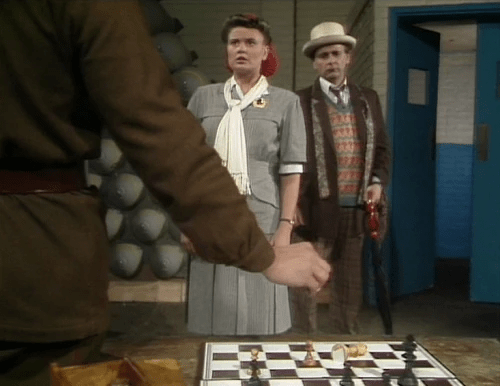
This fundamental idea behind the Prisoners’ Dilemma appears in a number of ways throughout the story. The most obvious of these is the chess puzzle presented by the Doctor as a challenge for Fenric to solve. The solution is revealed to be an unintuitive yet rather straightforward move involving opposing pawns uniting in order to reach checkmate, but logically this seems rather bizarre. As Sandifer wryly observes, “the fact that the chess puzzle and its solution are completely non-sensical, that a mate-in-one puzzle that stumps an ancient god for ages is ridiculous”13.
However, thematically it ‘rhymes’ (in the George Lucas sense) with the narrative at-hand. The Doctor’s chess puzzle is a mirror of the real-life game happening right now at the secret military base, and is used by him to showcase the flaw in Fenric’s strategic outlook; he cannot fathom the possibility that the pawns might not kill each other at the first possible chance, the clear dominant strategy, or to actively choose to work against the premise of the game itself. The pawns then, represented by Bates and Vershinn, choose to work together in order to achieve the best outcome for themselves rather than as individuals. Cooperation over competition.
Then there’s the Ancient One. For most of the narrative, he is used as a game piece by Fenric, who belittles and barks orders at him, in order for him to reach his desired outcome of the chemical pollution of the entire world. But, as I mentioned earlier, we are witnessing a game within a game.
The Doctor works to redefine the rules of the game being played. He persuades the Ancient One to stop being a pawn in Fenric’s game, essentially exiting the chessboard, and instead becomes a player in the game, substituting into the Doctor’s place. This entraps Fenric in a game where he cannot foresee the winning move, and now he must face the consequences of mistreating his own game piece. And since the Ancient One now believes that mutual cooperation between them is no longer possible, they are left only with the option: to betray each other. Mutually assured destruction.
This outcome is the flipside to Bates and Vershinn. The Curse of Fenric’s resolution presents us with both ‘winners’ and ‘losers’ of the Prisoners’ Dilemma. Of course, this reading assumes that we actually witnessed the end of Fenric, but the expanded universe may have other ideas. (See, for example, Gods and Monsters by Alan Barnes and Mike Maddox.)
Margaret Thatcher once famously said, “There is no alternative.” But unfortunately for her, she’s wrong. So what is the alternative? The alternative reading is that we witnessed just one of many iterations in the ongoing battle between the Doctor and Fenric. What then does such a game look like? Let’s dare to imagine such a thing.
Consider the notion that the Seventh Doctor and Fenric are playing the most elaborate and extraordinary game. One with an impossibly large number of options for each of them to choose from, the combinations of which are so mid-bogglingly high that we cannot illustrate them using a mere two-dimensional grid. And the potential pay-offs are not just points on a scoreboard but the lives of countless individuals, ordinary people like you or me, as well as the continued existence of our world. The whole of time and space at stake. A game that started long, long ago and will continue until the end of time.
The political scientist and philosopher Francis Fukuyama argued that humanity had reached “the end of history” following the end of the Cold War and the dissolution of the Soviet Union. That humanity had now reached some sort of stable liberal democracy. He said that in 1992. I look around at the state of the world in 2025 and can’t help but disagree. The Curse of Fenric, written three years prior, appears to feel the same.
The end of history? Far from it.
“We play the contest again, Time Lord.”
Bibliography
- Alex Through the Looking Glass by Alex Bellos
- A Mathematician’s Apology by G. H. Hardy
- Fermat’s Last Theorem by Simon Singh
- The Black Archive #23: The Curse of Fenric by Una McCormack
- TARDIS Eruditorum Volume 7: Sylvester McCoy by Elizabeth Sandifer
- The Simpsons and Their Mathematical Secrets by Simon Singh
Next Month: Time for an OFSTED inspection…

 The Brain of Möbius
Leave a comment