
“The Earth isn’t my home, Sarah. I’m a Time Lord… “
– The Doctor, Pyramids of Mars (1975)
Previously on this blog, we discussed how embarrassing it was that the author of Doctor Who: The Complete History – Issue 41 / Volume 32 could not count how many sides there are on a dodecahedron. Since dodecahedrons can be quite a challenging shape to master, and the Doctor Who fandom is not renowned for its mathematical literacy, I have decided to write a much more entry-level blog for this particular audience, addressing the dodecahedron’s simpler and more widely-known cousin: the cube.
The cube, also known as the hexahedron, is a Platonic solid consisting of six sides (or faces), eight corners (or vertices) and twelve edges. A Platonic solid is a regular, convex polyhedron in three-dimensional space, meaning that every side and angle of the shape are congruent (i.e. the same) and every face is the same regular-sided polygon. There are only five of these Platonic solids that can exist within three-dimensional space. Here is a picture of them.
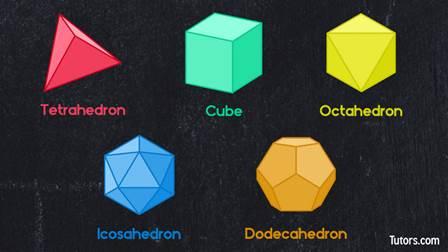
Fans of board games or role-playing games might recognise the Platonic solids as the shapes of dice used when playing such games: a tetrahedron is a D4, a cube is a D6, an octahedron is a D8, a dodecahedron is a D12, and an icosahedron is a D20. Their natural geometric properties make them ideal for games that require elements of random chance and they’re also quite aesthetically pleasing to look at.
Cubes are especially prominent within the Eleventh Doctor era. In The Time of Angels (2010), the Doctor steals a Home Box from a museum, upon which there is an inscription written in High Gallifreyan that reads “Hello sweetie”, allowing him to save River Song. In The Pandorica Opens/The Big Bang (2010), the Doctor and Amy Pond are, in turn, imprisoned within the Pandorica, which takes the form of a very large cube. In The Doctor’s Wife (2011), the Doctor receives a tesseract, or hypercube, purportedly containing a message from the Corsair. These hypercubes were originally introduced in The War Games (1969), the final TV story of the Second Doctor portrayed by Patrick Troughton, whose performance was a notable influence on Matt Smith when researching on how to play the role for himself. And of course, there’s The Moment in The Day of the Doctor (2013), a Gallifreyan weapon in the shape of a humble cuboid. Wherever you look, there are cubes!
But the award for ‘Most Blatant Appearance of Cubes within the Eleventh Doctor Era” goes to The Power of Three (2012), or the one about the “invasion of the very small cubes”. The title is an obvious piece of wordplay, revolving around how the mathematical term ‘cubed’ literally means ‘to the power of three,’ whilst exploring how the relationship between our three lead characters – Amy, Rory and the Doctor – develops over the course of a year when cubes came to stay on Earth. This would be an insightful piece of commentary by yours truly were it not for the fact that the episode’s author, Chris Chibnall, decides to egregiously whack this unsubtle detail over the audience’s collective head in the final epitaph.
AMY: So that was the year of the slow invasion, when the Earth got cubed, and the Doctor came to stay. It was also when we realised something the Shakri never understood. What cubed actually means. The power… of three.
And if you thought that was painful, wait until you hear the one about having a conversation. However, once you consider the symbolic nature of the cube, one is able to perform a closer read on the episode’s plotline and themes.
The Platonic solids were recognised by several ancient cultures for their ‘sacred geometry.’ The five Platonic solids were believed to represent a model for the universe comprising of each of the five classical elements: the tetrahedron represented fire, the hexahedron represented earth, the octahedron represented air. the icosahedron represented water, and the dodecahedron represented the aether that holds the universe together. This informed the belief of the mathematician Plato (c.427 – c.347 BCE) that God was a mathematician who used these shapes to design the whole universe that we inhabit. What we should be really focussing on here then is that the cube is a symbol of earth.
Cubes can be found across the earth in various forms. Crystals of salt and pyrite (Fool’s gold) can form in the shape of cubes, there are temples and buildings in the shape of cubes can found all across the world, and the popular sandbox video game Minecraft has a cube-shaped block of earth as its iconic desktop logo. Whether it be natural, man-made or digital, cubes can be found far and wide across planet Earth.
I think it’s especially interesting that the Shakri, about whom we know so little, choose the cube as the symbol for their ‘slow invasion’ of Earth. There’s an inherent irony that the cube is literally a symbol of the planet which they are attempting to invade. Perhaps their choice is a source of amusement for the Shakri, mocking us as a species for our general ignorance, or perhaps it is some sort of taunt against us? We’ll probably never know for sure.
The cube is also a symbol of stability and permanence. Within the episode, Amy and Rory are trying to find some form of stable lifestyle but are caught in between having an ordinary slow-paced ‘normal’ life and having an exciting action-packed ‘adventurous’ life with the Doctor. They are struggling to find the natural equilibrium which they desire. Every time that Amy and Rory hop away for a trip in the TARDIS, they come back to Earth only to be constantly surrounded by symbols of the very thing they don’t quite have: stability. Again, the cubes appear to be taunting them.
Given that the cube represents the Earth, it is commonly thought among several ancient cultures that the sphere is the natural counterpart of the cube, and so this in turn represents the Heavens. The Eleventh Doctor is at one point described as ‘the lonely God’ so it seems rather fitting that The Power of Three is a story about how this ‘God’ should decide to leave Heaven (i.e. all of time and space) to spend time living on Earth with his human companions. Indeed, the Doctor is obsessed with the Earth, always returning back here to this one planet. This is paralleled within the episode as he obsesses over what these cubes actually are and investigates why they have suddenly appeared. The cubes act as a symbol of his special interest in planet Earth; they are also there to taunt him.
If I were in the unlikely position to novelise The Power of Three in the form of a Target book, I would be tempted to surreptitiously change the Shakri’s spaceship into the shape of a sphere. This would symbolically place the Shakri as a god-like entity looking down on the Earth, taunting and tempting us with strange, small cubes used to monitor our behaviour and test our character, not unlike the tests set by God to characters within the Old and New Testaments of the Bible. If it were not for out three heroes within the story, the human race would have been punished most severely by the Shakri for failing their test.
At the end of the episode, with the blessing and encouragement of Rory’s dad Brian Williams, Amy and Rory decide to go on further adventures with the Doctor, ultimately rejecting the safe and stable homelife they have built on Earth. How tragic then that they are arguably punished for their decision in the very next episode of the show, The Angels Take Manhattan (2012), forced to ultimately live together in a place and time that is not their own. The universe has found its own way of subjecting a stable and permanent onto these two time-travelling companions.
As for the Eleventh Doctor, he makes his own permanent residence on the planet Trenzalore in The Time of the Doctor (2013), before ultimately regenerating. After running across the universe faster than he has ever run before, it’s quite fitting that he spends the final centuries living out his life in one point in space and time, holding back a universe of monsters who want to make contact with another point in space and time, the pocket universe within which Gallifrey and the Time Lords are secured within. As narrated to us by the Doctor during the ending of the preceding episode, The Day of the Doctor (2013), he is and has always been journeying towards home; he’s just taking the long way round.
Next Month: Something that starts from nothing…

 The Brain of Möbius
Leave a reply to Pting? Gone! – Pentagonal Numbers in The Tsuranga Conundrum – The Brain of Möbius Cancel reply